Inside the Mind of ZHA Architects’ AI Pioneer | Shajay Bhooshan
Shajay Bhooshan co-founded ZHA Code with a three-week crash course in writing code. That was 20 years ago.
Shajay Bhooshan co-founded ZHA Code with a three-week crash course in writing code. That was 20 years ago. The computation and design research group he built inside ZHA now has 28 people and feeds directly into every project the practice takes on.
He grew up in India, came to London in 2004 for his masters at the AA’s Design Research Lab, and picked up coding during a brief trip back before joining ZHA. At a practice defined by forms nobody else was building, he was one of the few people who could write the tools to make those forms computable. ZHA Code grew from there: one person, one skill, one practice that needed it.
This conversation covers how computation shapes design at ZHA from the first sketch, what the AI moment actually changes for the profession, why your architectural vocabulary determines what AI can give you, and why the first ten years of your career should be treated as investment, not performance.
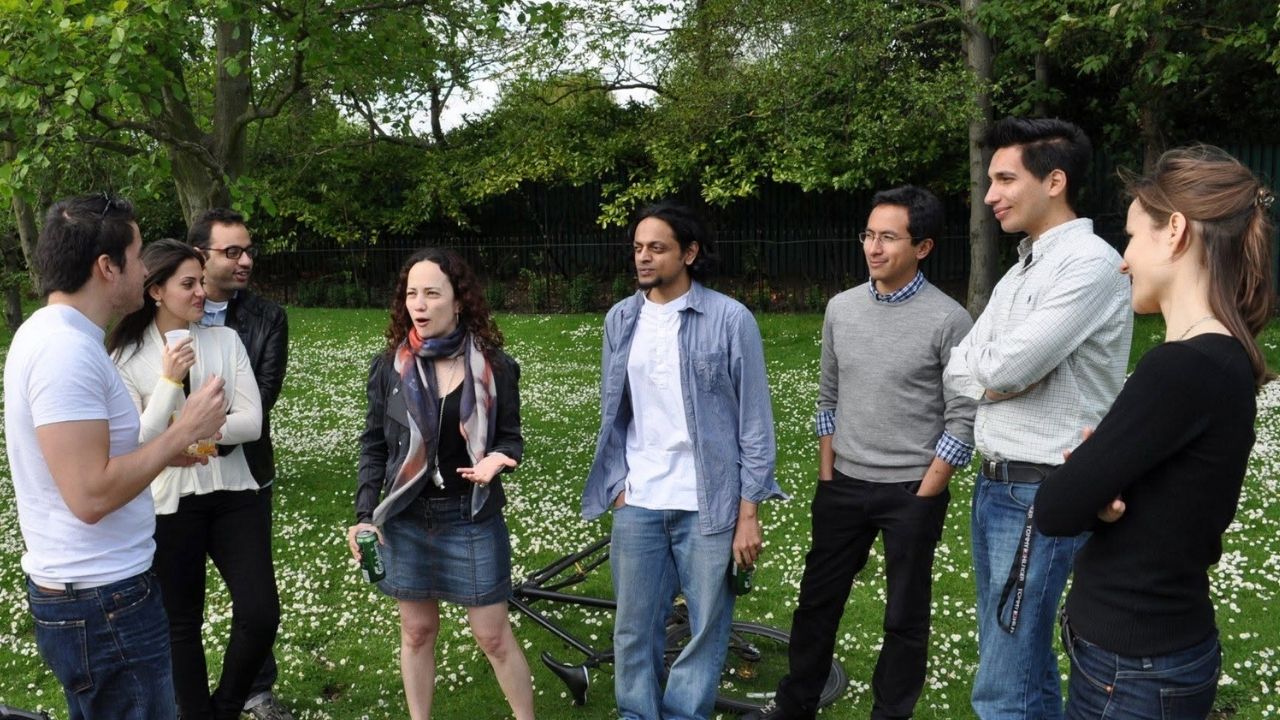
Shajay with the Design Research Lab community at the AA, where he studied in 2004 and has taught ever since.
Always Closing It. Always Increasing It.
 Bespoke Careers
Zaha Hadid’s original work was famously ahead of its time — ahead of what the construction industry could actually deliver. How much of your work has been about trying to close that gap?
 Shajay Bhooshan
It’s not only our work internally — it’s all our collaborators. Engineers, contractors, the client. The intention has always been to create something that pushes everybody else. So the gap will always be there, because you’re moving as you go.
If the gap is closed, there’s a genuine allergic reaction internal to the company — we have to experiment more. We always try to close the gap, but at the same time, we simultaneously try to increase the gap.
Bespoke CareersHow did ZHA Code come about? What were you trying to solve?
Shajay BhooshanI had just graduated from the Design Research Lab at the AA. At the time there were very few people who could actually write code. I’d gone to India and learned to write code for about three weeks, then found an application for it. That’s how we started. Ever since, we’ve grown one person a year as the company grows. Now we’re about 28 people.
We have a mandate of about 30 to 40% project-independent exploratory work. Then we’re always looking for the first pilot project to apply something. Every client gets something new. In many ways, every project is benefiting from our project-independent work — but at the same time, no single project falls apart if we don’t contribute.
Bespoke CareersWhat are those categories of exploration? How do they take shape over time?
Shajay BhooshanThe baseline is high-performance geometry: how do you create shapes that are structurally lightweight, environmentally performant, easy to construct. We started that in 2004, 2006. Then robotic fabrication came into the picture around 2012. Then video games and participatory architecture came along. On those three or four pillars we’ve created services: facade rationalising, construction twins, BIM 2.0. Over time, things mature into specific topics.
“
If the gap is closed, there’s a genuine allergic reaction internal to the company that we have to experiment more.
Not on a Project Worth Millions
Bespoke CareersThe work you’re doing is basically providing evidence that something can be built — building the case before you ever take it to a client.
Shajay BhooshanExactly. And it’s not only providing evidence — the words we use will reflect the fact that we have thought about many different aspects of the same topic. We don’t directly apply something on a project that’s worth millions of dollars. Because it’s public resource. Most of the projects we do are public. There’s a lot of scrutiny.
It’s unlike the popular perception that clients come to us with a big budget. Never the case. We’ve gotten very good at building up the case: what are the benefits? How do you communicate the benefits to the client, and to the client’s clients — the end users — and then what are the costs?
We do small prototypes in academia. We’ve done many workshops. We now have a robotic fabrication lab inside the company. It familiarises designers with the technology so that when they talk to clients, they’re not just talking through their hat. Asking for money is always an interesting way to gain confidence. It’s another skill set entirely.
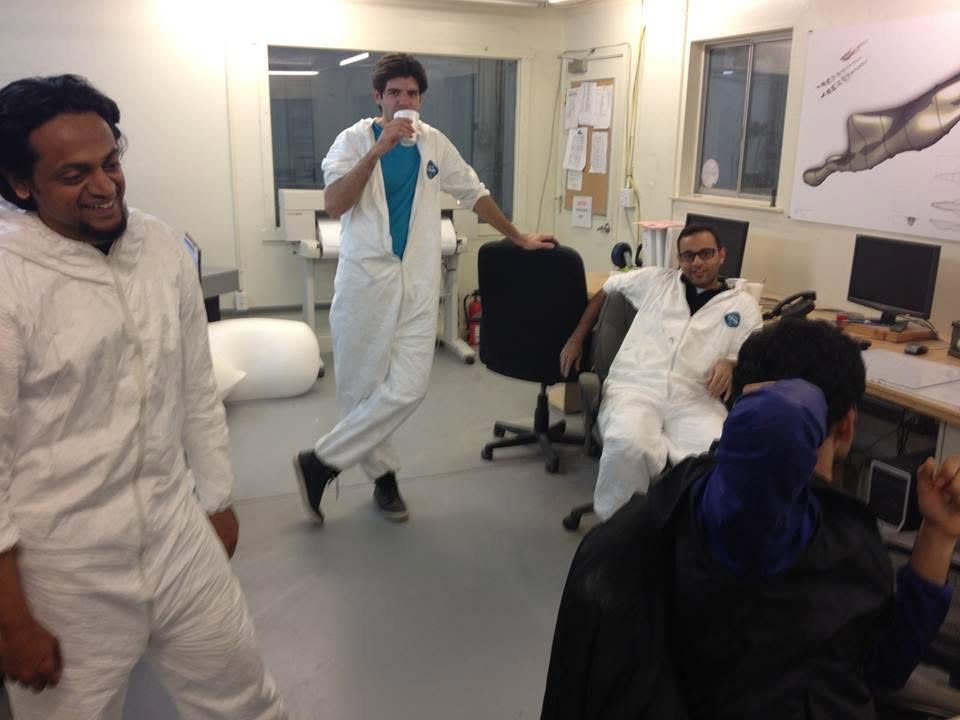
Prototyping at Kreysler Associates, San Francisco, 2013. Testing ideas in the physical world before they reach a live project.
“
We don’t directly apply something on a project worth millions of dollars. Because it’s public resource. There’s a lot of scrutiny.
Students Are the Sensors
Bespoke CareersYou don’t draw a line between what you do in the practice and what you do in education. How does one feed the other?
Shajay BhooshanEducation for us has always been in the co-exploration of any new technology, new architectural topics, discourses. We don’t make a distinction between experimentation in the company and blue-sky experimentation with students. It’s always bidirectionally beneficial. Students get the benefit of professional input. And whatever was a thesis project, five or six years later there’s some version of it that got built. The Baku project, the train station in Innsbruck — all some cohort of people who developed those ideas.
Students are the sensors in the real world. Especially in a place like London — it attracts people from everywhere, quite likely the very best from everywhere. London is amazingly dense. You can go to Heatherwick’s office, then the AA, then ZHA, then meet somebody in a pub. In North America you can have one meeting a day and three hours in a car.

At a Zaha Hadid masterclass with students at the University of Applied Arts Vienna. Rehearsing ideas in education before they reach a live project.
“
Whatever was a thesis project, five or six years later there’s some version of it that got built.
The Creative Wildfire
Bespoke CareersSomeone in your position has probably understood AI for a while. Where do you sit on this thing, and how has it evolved ZHA’s work?
Shajay BhooshanPatrick recently wrote an article about the creative wildfire that image AI set off. That was definitely a spark that attracted everybody — because of the strangeness of the images and the ease of creating them through text. It aligned well with this tradition of the found object: you’re always looking for that curious thing. That was the amazingly surprising, novel thing about image AI.
It was a sufficient Trojan horse for other less exciting-looking technologies but maybe more practically applicable. Now Claude is writing a lot of code, making presentations. Image AI was the spearhead moment that opened up a lot of creative discourse.
From an interest in computer graphics, I always think of AI being able to discover the so-called Move 37. The game between Google DeepMind’s AlphaGo and a human player — there’s this famous moment when it created a move nobody expected. AlphaGo then became AlphaZero, played chess, and trashed other chess software 100 to zero. Most people found that AlphaZero was playing a very human style of chess: sacrificing many pieces, very creative play. To me, that’s the holy grail of creativity-enhancing AI.
Computational design has this general perception that it’s a linear thing — you hit the script and get a result. The reality is it’s a reflective mode. You do something, the computer does something, then you react to it and do something else. It’s going to be a creative co-partner for a long time. It doesn’t feel like it will in any way replace anybody. It will only mean architects can do more.
“
Computational design has this perception that it’s a linear thing. You hit the script and get a result. Reality is it’s a reflective mode.
Latin Gets Deeper Into the Brain
Bespoke CareersIs the communication piece — being able to articulate architectural intent precisely — what actually shows the architect’s value now? Saying AI does the pretty pictures feels like such an oversimplification.
Shajay BhooshanThe other day someone mentioned that lawyers, since they use Latin, can get into the depths of the LLM brain much more than English can — because the Latin phrases are so condensed. It projects the words into parts of the brain of the LLM that are not normally accessible.
That’s genuinely true on a day-to-day basis. Having words for certain things means you can communicate with AI. If you don’t have words for certain things, you can’t prompt it correctly. If you have a word for a certain kind of arch — the voussoir — you need those words to get the detail correct.
Disciplinary discourse is going to be extremely valuable. These are general-purpose models — by definition, they cannot get into the specificities of professions. Architecture, law, any of the well-established professions. You can’t get there because then it won’t be a general-purpose model.
“
If you don’t have words for certain things, you can’t prompt it correctly. Disciplinary discourse is going to be extremely valuable.
Sovereign Intelligence
Bespoke CareersZHA is a large practice with 20 years of built work and a very specific design intelligence. Is that — the model being trained on all of your past projects — part of your IP?
Shajay BhooshanWe’re not particularly bothered about what it already knows. A general model will know about general things — it knows about Gaudi, it knows about our work, it knows about Foster’s work. That’s fine. It’s the customisation that we want to treat as our IP.
Moving forward, I think all firms have the ability for what I call sovereign intelligence: data sovereignty and intelligent sovereignty. That is your IP and you shouldn’t be giving it up to software companies. Which has been an anomaly in the last 30 years: you create the value, the client pays for it, and in between a lot of that value is gone just because some software helped you produce drawings.
With a $20 subscription, you can create a custom piece of software and retain all of that intelligence. Once you have that, you can make it more clever with every client. The same way ChatGPT eventually knows you — your software can know you and your practice. The state-of-the-art is available to everybody.
The Project
Mathematics: The Winton Gallery





ZHA. Science Museum, London. An exhibition bringing together more than 100 objects from the museum’s world-class STEM collection to tell the story of mathematical practice across four centuries — from trade and travel to war, peace, form and beauty.
The gallery’s geometry was derived from the aerodynamics of a 1929 Handley Page biplane, with every surface and structural element generated through a computational process. The kind of work ZHA Code was built to make possible.
Photos courtesy of Matt Danby, Archifocussed.
“
What I call sovereign intelligence: data sovereignty and intelligent sovereignty. That is your IP. You shouldn’t be giving it up to software companies.
Six Screens from Your Desk
Bespoke CareersWhat’s the experience of a young person coming into ZHA? Are they pushing you further, or figuring out how these things relate to the real world?
Shajay BhooshanZHA has always been fascinating in that sense. It’s very bottom-up and it’s a very open office. Even Patrick, our senior management — nobody has their own desk. Everyone is hot desking. Nobody has their own office. Which means you can always see and hear everything, and that’s extraordinarily useful when you’re young.
Our tables are about 20% shorter deliberately. There are two screens, and then the next screen is literally right there. You can see from your desk at least six screens. That’s an enormous amount of information you’re processing daily.
About 60% of our work is by competing, not direct commissions. Which means we have to be extremely good and fast at creating design options that resonate with the brief. We grow cohort by cohort. When Zaha started it took 20 years before the first project got built. Some of my students now come in with zero experience and at the end of four years they’ve built a stadium. That’s a remarkable compression of experience.
“
You can see from your desk at least six screens. That’s an enormous amount of information you’re processing daily.
Treat the First Ten Years as Investment
Bespoke CareersHow do you reflect on the generation coming through now compared to when you joined?
Shajay BhooshanIt’s a fantastic time to be an architect. I genuinely believe we can elevate again to standing shoulder-to-shoulder with other professions. We’ve lost ground over the last 30 to 40 years, increasingly seeding territory from our services. Now we can provide more valuable services — design strategy, before a single line is drawn.
If we can treat the first 10 years of your career as investment rather than burden, it will be very rewarding. Architecture is so multiply capable that almost literally everybody can have a unique career path. I lead a team where people come for two, three, five years. Some went on to do startups. One of the most successful alumni of Code is now running a biolab startup employing 400 people. Some went to MIT for PhDs. Others went back to India or have their own practice.
A lot of opportunities come once you think of the first 10 years as an investment period.
“
It’s a fantastic time to be an architect. I genuinely believe we can elevate again to standing shoulder-to-shoulder with other professions.
A $100 Subscription
Bespoke CareersZHA is at the vanguard with resources most practices can’t match. What actually trickles down to a three-person firm?
Shajay BhooshanIt’s been eye-opening over the last two or three years. I travel a fair bit to India, Canada, North America, and by and large firms there are three people, five people. They spend a lot on certain software. But if you invest a fraction of that time and money on a Claude Pro subscription — $100 a month — you’ll see benefits immediately.
Architecture is a linear profession. The revenue per employee, whether you’re a 30-person firm or a 500-person firm, is almost exactly the same. So if you can make it work in a three-person firm with a $100 subscription, it’s super exciting. Before, you’d have to invest a year learning Grasshopper. A lot of upfront cost. Now, coding is solved. Just chatting.
My father’s firm is literally a single person. He just chats away.
“
Coding is solved. Before you would have to invest a year learning Grasshopper. Now it’s just chatting.
Quickfire
Biggest mistake of your career, and what did it teach you?
Shajay BhooshanI didn’t feel confident enough to go to China when a lot of my colleagues did. Post-2008 Olympics, the country gained so much confidence because they built so much. That would have been an amazing experience. I regret not having the confidence to go when they did.
One piece of advice to your younger self?
Shajay BhooshanGet to a large city as quickly in your career as possible.
Who in the architecture world do you most admire?
Shajay BhooshanPatrick Schumacher, absolutely. Professor Philippe Block. My own wife, who has been extraordinarily entrepreneurial. And Theodore Spiropoulos, director of the DRL, who helped calibrate my career academically and professionally.
Biggest misconception about architects?
Shajay BhooshanThat we’re still using pencil and paper. That we’re not as advanced technologically. I do believe we are advanced. It’s just not evenly spread, and not evenly communicated.
Are architects underpaid?
Shajay BhooshanYes — to the extent that we don’t claim enough value for the work we do. Part of that is learning to reason economically early in your career. It doesn’t mean being oblivious to the needs of clients. We are ultimately in the service of a client and the end user. We need to communicate the value we actually provide.
Favourite building in the world?
Shajay BhooshanThe Sagrada Familia. It’s mad, but it’s a collaborative building that took many artists and a lot of technology for its time. Gaudi himself worked on it for 33 years. Mark Burry, who rediscovered most of the lost knowledge, worked on it for another 36. A mad building. Absolutely my favourite.
What do you know now that you wish you knew when starting out?
Shajay BhooshanThat architecture and architectural technologies can be so empowering. It didn’t feel like that when I started. Now I think it’s extraordinarily empowering, and the value we can provide to society is genuinely rewarding.
Most overrated trend in architecture right now?
Shajay BhooshanReflecting too early on your career. The first 10, 15, 20 years — you should be invested in doing everything and anything that comes your way.
Is an architecture degree still worth it in 2026?
Shajay BhooshanArchitecture is an extraordinarily useful degree because of the downstream career paths. You have to know enough about people, economics, emerging technologies, social media, images, compositions, graphics. It’s the mother of all professions.
One thing architecture school gets completely wrong?
Shajay BhooshanForgetting that we are both a discipline and a profession in the service of a client and the end user.
How will AI change the junior architect’s role?
Shajay BhooshanAmplify it even more than it is currently. You bring the energy and try to absorb all the experience of senior people in exchange. With AI, that’s going to be exponential — because you need enormous mental energies to explore the breadth of things that are now possible.
What will AI never replace in architecture?
Shajay BhooshanHuman judgment and the desire to subvert a process in the search for novelty. Something quirky, peculiar, that you just know.
What are you worried about for the future of architecture?
Shajay BhooshanThat if we don’t actively participate in steering AI — if we sit it out — we’re going to miss this generational opportunity. Because we’re scared, or because there’s a general perception of risk aversion. Don’t ask what AI can do. Ask how AI can help you.
Search for architecture and design jobs here
Latest architecture and design jobs around the world


Looking to hire top talent
 or advance your career? Let's talk.

We connect exceptional firms with talented professionals.
Let’s discuss how we can help you achieve your goals. Get in touch with the team today.
Related Posts


Here is what our industry experts have been seeing in California
We spend roughly a third of our adult lives at work. A third. That’s about 90,000 hours over the course of a career.
And yet, many of us have never stopped to really think about how our physical environment is shaping our mental health, our productivity, and our overall wellbeing every single day.
Architects and designers in Australia have a wide range of events occurring in 2026. From networking events, opportunities for learning and even some socialising, the calendar is shaping up to be a varied and interesting mix of events.