
What the AIA President Wants Every Architect to Know | Illya Azaroff
For over 30 years his work has focused on disaster mitigation, resilience planning and regenerative design: helping communities prepare for, respond to and recover from crisis.
Illya Azaroff is the 2026 president of the American Institute of Architects, founding principal of +LAB Architects in New York, and a professor at the New York City College of Technology. For over 30 years his work has focused on disaster mitigation, resilience planning and regenerative design: helping communities prepare for, respond to and recover from crisis.
His father arrived in the US as a displaced war refugee from Ukraine. Illya grew up in tornado alley, in a household where helping after a disaster was what you did, and took a degree in geography before architecture. He calls architecture his side gig. That side gig has taken him into disaster zones all over the world.
This conversation covers what the AIA presidency looks like from the inside, why his children are the reason he ran, what people who have lost everything teach you about being human, and what he wants every architect to know: you are more powerful to your community than you realize.

Illya Azaroff. Image credit: American Institute of Architects.
A Machine You Build the Year Before
 Bespoke Careers
You’re about halfway through your tenure as AIA national president. What has the role been like from the inside? What’s different than you thought it would be?
 Illya Azaroff
It’s been challenging, certainly. The time constraints are something I expected, but sometimes they’re extreme. Balancing practice with this commitment has also been a challenge. But what’s been amazing is to see the inside of the AIA and the incredible amount of dedicated people that are there to move your vision forward. I’m enjoying the board of directors and all of the people who are dedicated to getting to the same place: a better profession and a better world.
Bespoke CareersThe one-year presidency is a short window to come in and have an impact. How does that time pressure shape the way you work?
Illya AzaroffIt’s really a three-year presidency. That’s the misperception. You’re on stage for this one year, but your president-elect year is your major preparation year. All of the mechanics and the engines were focused in the right way. So it’s really driving a machine that you build behind the scenes the year before.
That being said, there is pressure, because you’re always thrown a curveball. Something comes out of left field. That’s a constant. But I work in disaster management in a lot of cases, so dealing with last-minute shocks and stresses is nothing new. I’m kind of built for this kind of work.
“
It’s really driving a machine that you build behind the scenes the year before.
My Why Is My Family
Bespoke CareersYou’ve been involved in the AIA for a long time. What made you decide it was worth that level of commitment? You’re a practising architect, a professor, all of these other aspects.
Illya AzaroffI’ve thought about this a lot, and the answer is a little selfish, quite frankly. It’s nothing about position. Nothing about title. In fact, if the world was in a different place, you would not know who I am. My why is my family and my children. When you and I grew up, I could dream about being anything I wanted to be. I thought the future was a vast and endless horizon. My kids didn’t grow up that way. Children today do not see that future as a positive. They see it as fearful. There is a true and palpable fear of the future, and it freezes this generation.
So my why is I want to change that for everyone out there, especially my children. I want to push that time horizon back and give them the hope that I had when I was growing up. Getting involved with the AIA was looking at the best lever I could grab hold of to make the biggest amount of change possible for those kids. If I can elevate this issue to action to 100-plus thousand architects around the world, that’s going to change the story.
“
I want to push that time horizon back and give them the hope that I had when I was growing up.
Architecture Is My Side Gig
Bespoke CareersWhere was the first seed of architecture? And geography has played a massive part in your career. How did those two things come into the picture?
Illya AzaroffI’m first generation born in the US. My father came from Ukraine and was a displaced war refugee. Usually it took the form of sitting at the dinner table as a young kid, not wanting to eat what’s in front of you. My father would express he knew what hunger was. He knew what not having food was. He knew what cold and fear and everything that comes with disaster displacement comes with. His object lesson was understanding that there are people around the world that are suffering every day. Coupled with growing up in tornado alley, there were a lot of instances where my family would help after a disaster.
When I went to university, my first degree was in geography, environmental studies, and then architecture. So it’s kind of funny, architecture is my side gig. But geography has underpinned my whole essence of being and my way of approaching architecture.
We can create architecture that can withstand the forces of mother nature. We’ve proven it many times. Science stations in the North Pole. Underwater research stations. Scientists work with NASA for the vacuum of space. We’ve been doing it a long time, and in a very profound way. It’s only political will and money that holds us back from creating resilient communities.
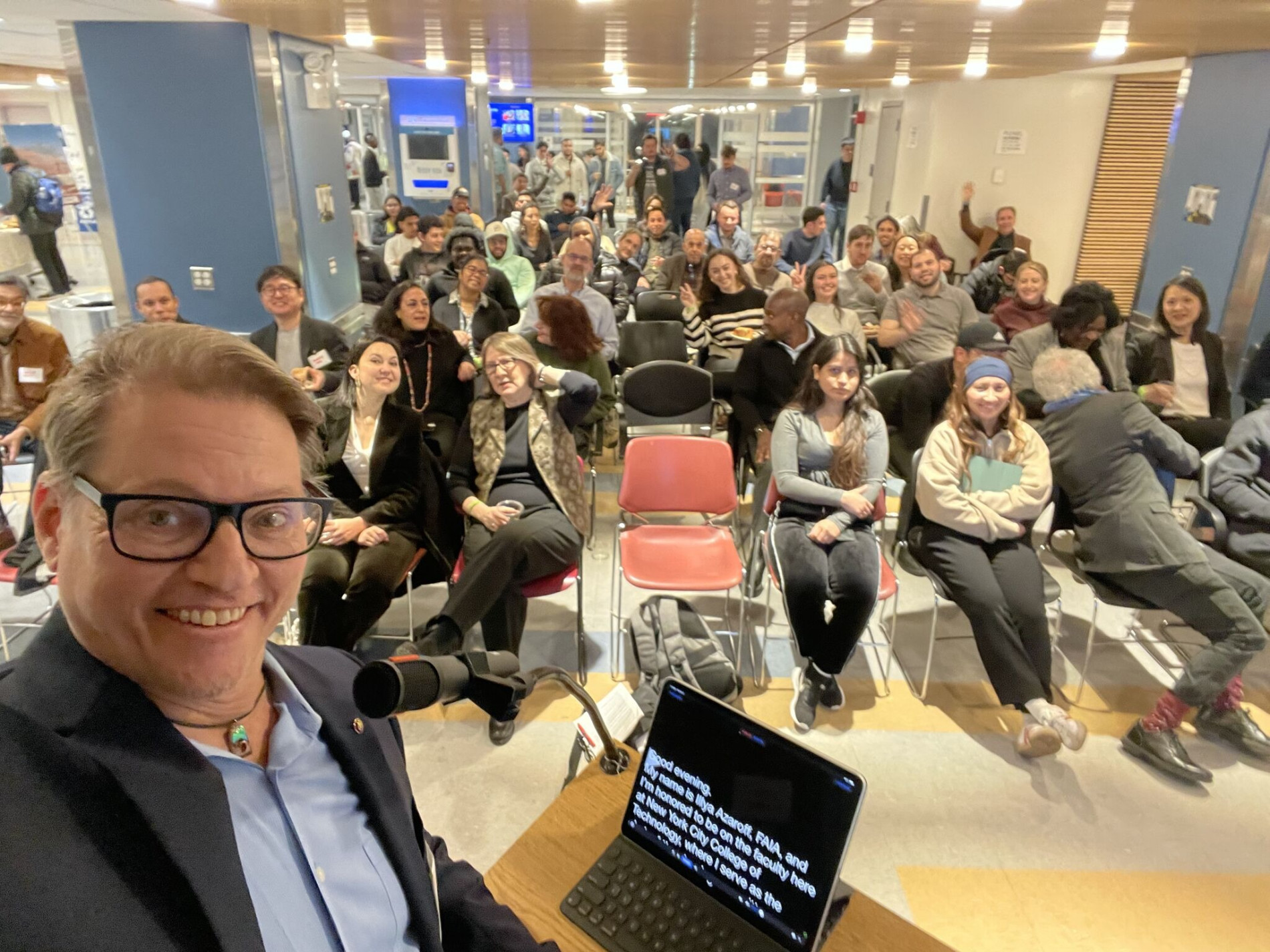
Illya with students at the New York City College of Technology. His first degree was geography. Architecture came after.
“
It’s only political will and money that holds us back from creating resilient communities.
Fear and Love
Bespoke CareersThe generation coming through also has this fluctuating noise of AI, potentially a paradigm shift in the working world. How do you and the students approach those conversations?
Illya AzaroffThat is something so present at the moment. We approach everything through fear and love. A lot of architects and faculty members are afraid that AI is going to circumvent or render useless the methodologies we’ve traditionally relied on. I am the opposite. I was at the cusp of when we were going from hand drafting to AutoCAD. Oh my gosh, it’s a cataclysmic change. Then the advent of the internet and the boom of information technologies. These have all become adopted tools that have made us more powerful in the marketplace.
With the students we talk about the value of critical thinking and systems thinking to develop your mind, so you can take control of this powerful tool. A lot of it starts with being honest and upfront: this will not do the work for you. It will enhance the ideas that you have. Your ideas are primary. It’s been said you can become the 700-person firm through yourself, you can be those 700 people, but you need to understand those systems to pull the levers properly. And the students bring ideas to us that we’ve never heard of. That’s the best.
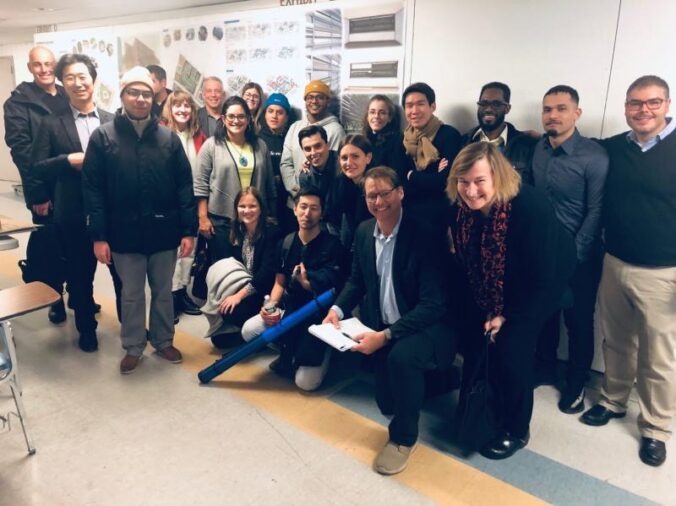
Reviewing student work at City Tech, where Illya teaches every semester.
“
This will not do the work for you. It will enhance the ideas that you have. Your ideas are primary.
The Imperative of Our Time
Bespoke CareersFor a long time sustainability has been a nice to have. Something we push on clients alongside the brief. Are we at the point where people are asking for it as the brief?
Illya AzaroffWhat’s happening with the climate and the effect on our communities and the ecosystems around the world is the imperative of our time. It’s unfolding in real time. We’re having wildfires in places that never had them before. Flooding where we’d never had it before. The ethical charge of an architect is the health, safety and welfare of the public, so the absolute minimum is to understand what these risks are. Not just today but tomorrow.
That building will have many lives after that first client. Many occupants. You’re designing for today, but you’re really truly designing for tomorrow. So now you must look at what the shocks and stresses are and remove the risk through your design. Disaster risk reduction is an absolute that you must take on.
And clients are asking for it. We have a long list of people who have come to us just because of our expertise in disaster risk reduction and resilience. In the US, nearly 40 to 50% of small businesses do not come back after a disaster, because it’s three to six months minimum closed down. Everyone is asking for steady state, so they can be thriving before, during and after disaster. And these are not just commercial clients. Some are residential clients. They want that now in the marketplace.
“
You’re designing for today, but you’re really truly designing for tomorrow.
Half of Nothing
Bespoke CareersDisaster response is an aspect of architecture most architects will never experience. Tell me about an early experience of it and the lessons you learned.
Illya AzaroffI’ve responded to disasters all over the world, and it does change you when you look into the eyes of people who have lost everything. I wish every architect could see this. But what really changes you is the humanity of those exact same people. Although they’ve lost everything, their humanity is still being gracious, trying to give you a gift or thank you for being there. When they have nothing, they will still give you half of nothing, whatever they have.
Quite frankly, I learn more from the people I’m trying to help than I bring to them. I learn about their culture, their place, their why of doing what they do. It’s how people experience loss and how people express humanity in the most dire of circumstances. And that gives me hope.
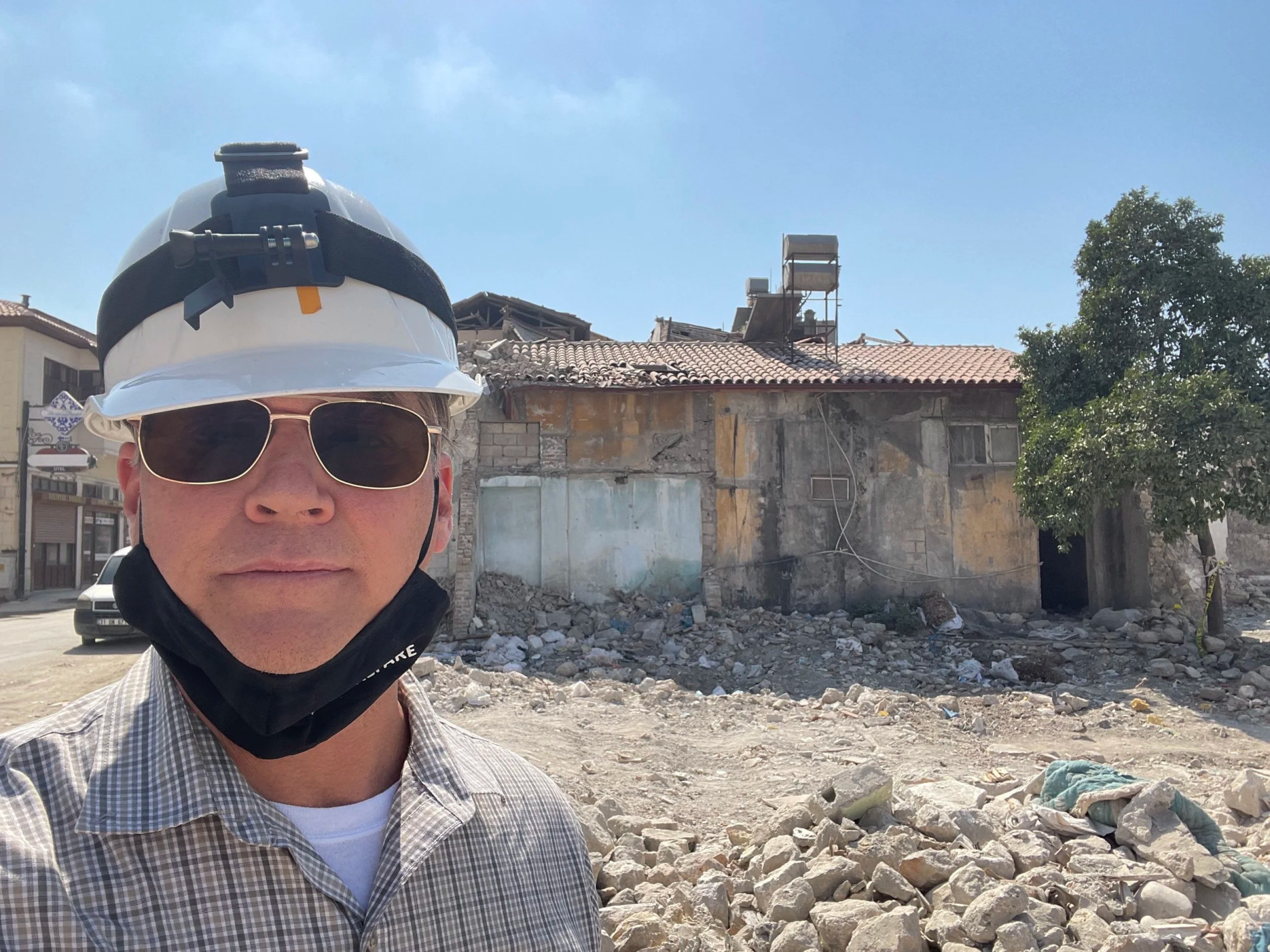
Turkey, 2023. On the ground after the earthquakes. Illya has been doing this work around the world for 30 years.
“
When they have nothing, they will still give you half of nothing, whatever they have.
Raising the Floor
Bespoke CareersHow do the findings from these events feed back into the design of new architecture? What’s that feedback loop like?
Illya AzaroffIn the US there are what’s called mitigation assessment teams. After a disaster, experts are assembled from around the country and sent to these locations to understand why things failed in that disaster and why things did not fail. That turns into a MAT report from every disaster. They’re online, for free. Those are fed to the International Code Council as recommendations for changing the next building code, and every three years the code is updated. Every three-year cycle, it begins to get to a place where we’re raising the floor for everyone.
Beyond code, there are advisories and better ways of building that get near-absolute protection for some building types. So we understand how to build better. Then it’s a matter of communicating the return on investment to your client: a larger outlay at the beginning, but overall they not only save money, they make more money.
“
Every three-year cycle, it begins to get to a place where we’re raising the floor for everyone.
More Powerful Than You Realize
Bespoke CareersMany architects feel constrained. By fees, by the planning system, by the risks they take on individually. Do they have agency to change these things?
Illya AzaroffI think they do, if we all pull together. One of the things I learned responding to disasters in the Caribbean was from a group called the Kalinago people. Their ethos is called koudmen: we all pull together. Your local component collectively has more voice and more visibility than a single architect. It’s easier when you share the load, because as you’re trying to advocate, you’re still trying to run a practice, put food on the table for your family, make sure your employees are healthy and paid.
Bespoke CareersEveryone is convinced by our own value, but as a profession we struggle to communicate it to clients, institutions, government and the public. At its crux, why do you think that is?
Illya AzaroffWe’re not trained in business. That’s a gap in our education. Professional practice and business classes were optional when I was in undergraduate school, and still today. You may have a professional practice class that talks about ethics and contracts, but they never talk about your value.
We need to look ourselves in the mirror and recognize how powerful we are. And this is a message for all of you out there: you are more powerful to your community than you realize. The history of the world is written today through its archaeology. That is just the surviving of architecture and some art. That’s it. When you think about what defines community, people immediately talk about a place. A square. A great building. That is the power. So tell ourselves what our value is, and act on that in the marketplace. Not in an egotistical way. In a factual way.
“
You are more powerful to your community than you realize.
Don’t Let Us Off the Hook
Bespoke CareersWhat would you say to the next generation entering the profession?
Illya AzaroffDon’t let us off the hook. There’s a lot of folks out there that say the next generation will solve this problem. Doesn’t matter what the problem is. What I want to tell the next generation: force us, the older generation, to continue to work on the problems that you’re facing. We can’t throw our hands up and leave it to you. That’s not fair to you.
And it doesn’t matter if you’re doing a small project or a large project. You change the entire chemistry of what’s happening around the world, if your intention is to heal the earth and heal the communities that you work in, rather than just cure. Curing is removing a symptom. Healing is regenerative. The power that you have is extraordinary.
My government has stepped away from commitments to the Paris agreement. Yet we as the AIA have stepped forward saying we will not step back. And architects from around the world, fellow organizations, have done the same thing. Architects globally will not step back. We recognize our value, and increasingly so.
“
Curing is removing a symptom. Healing is regenerative.
Quickfire
Favourite building in the world?
Illya AzaroffIt changes every day. Right now, probably the Sagrada Familia in Barcelona. I visited it 30 years ago, and I just visited a few weeks ago and they just topped out. I was in a complete building for the very first time, and it is astounding. It’s beautiful and it’s transcendent. It really lifts your spirit.
What do you know now that you wish you knew when starting out?
Illya AzaroffI wish I knew the business of architecture better, and how to run a company at the beginning. It would have moved my career a little bit further and faster.
Is an architecture degree still worth it in 2026?
Illya AzaroffAbsolutely. You’re getting a training that no one else gets. Systems thinking across the entirety of what society and building science demand, and it’s translatable, not just in architecture. You will find people trained in architecture in the broadest section of business and success in the world. Your training is unique. It is extraordinarily valuable.
One thing architecture school gets completely wrong?
Illya AzaroffThat one’s easy. Working on your own for a design versus working collaboratively on a design. In reality, you’re never doing design of a building and execution of a building alone. You’re doing it with a fairly large team.
Biggest mistake of your career, and what did it teach you?
Illya AzaroffI never really look back and lament about mistakes. I always try to be present and look to the future. I do know I’ve made mistakes that have helped me grow. They’re all part of growth. You’re always in a state of becoming. Every moment’s a teaching moment.
Who in the architecture world do you most admire?
Illya AzaroffI don’t think about architects all that much, even though I’m president of the AIA. If architecture is a reflection of culture, I look at people who are moving the world. People like António Guterres, secretary-general of the UN. Sheela Patel, who isn’t an architect but provides shelter and ways of building for informal settlements out of India. But if I had to get down to one, most recently, it’s Shigeru Ban. Here’s someone who responds to disasters and, in a very profound way, changed the way that architecture embraces community through some of the most extreme circumstances.
Biggest misconception about architects?
Illya AzaroffThat we are only about aesthetics, and that we are a luxury item to be added to a project. I think that is the biggest misconception.
Are architects underpaid?
Illya AzaroffI think architects are undervalued. So some yes, and some no.
What’s your biggest responsibility as AIA president?
Illya AzaroffFollowing through on what I promised. Making sure that we get more leaders to the table, and that we embody being the change we want to see in the world. Bringing all of my members’ hands to the table. That’s my biggest responsibility.
The AIA represents nearly 100,000 architects. What’s the one thing most of them need to hear right now?
Illya AzaroffThat regenerative design is our way forward, and that disaster risk reduction is all of our collective goal to make communities safe around the world while we heal the earth. That’s what every member needs to hear right now.
You’re an architecture professor. What’s the most important thing your students teach you?
Illya AzaroffWe’re always in a state of becoming. So you should always be open to learning new things from new people, about places and trends and things you’ve never heard of. That’s what keeps me alive and fresh. They teach me more than I teach them, that’s for sure.
If you could redesign one thing about how cities respond to disasters, what would it be?
Illya AzaroffThat they were designed to withstand those shocks before, during and after disaster. Much more resilient than they are today.
Does the AIA have anything organised for National Preparedness Month?
Illya AzaroffSeptember is National Preparedness Month. We’re going to be reinforcing how to bring resilience into your office and talk about it with your clients. We’re going to have safety assessment program training, so you can go into the field like I do after disasters. And many other advocacy pieces on how we make better cities. There’s so much during that month. Stay tuned.
Search for architecture and design jobs here
Latest architecture and design jobs around the world

Looking to hire top talent
 or advance your career? Let's talk.

We connect exceptional firms with talented professionals.
Let’s discuss how we can help you achieve your goals. Get in touch with the team today.
Related Posts

How can architecture practices adapt to attract and retain the staff they need? This was the topic of an AJ roundtable discussion in partnership with Bespoke Careers.