
What I learned as President of the American Institute of Architects – Evelyn Lee
Evelyn Lee is an architect, entrepreneur, and tech strategist who served as the 2025 President of the American Institute of Architects (AIA).
On the meaning of the word architect…
I think architects and the built environment go hand in hand. If you think about the idea of the centuries old master builder, architects were the orchestrators of these very large projects. I think that can extend beyond the site plan into a portfolio of projects as well. I am not talking about different clients, but working with a portfolio in one company with a portfolio of real estate. Holistically, an architect is a conductor of the built environment, but that takes on many more forms than just a single building.
On discovering architecture…
I didn’t fall into it so much as I was one of those crazy people that knew very young that I wanted to be an architect. It wasn’t because we had tremendous architecture in Los Alamos, New Mexico. It was because there were these plan books of Victorian homes in the grocery store that I would pick up every Sunday after church. I just loved to look at the plans. In fourth grade, my teacher said to draw your dream home. Typical fourth graders draw in elevation, but I drew mine in plan. It had an indoor soccer field and details down to the four Nintendo gaming systems I had in my room for sleepovers. That was the making of my first home.
On the path to university…
Los Alamos had a public library designed by Antoine Predock, who is a well known American architect in New Mexico. It is still to this day one of my favorite spaces. I have a lot of memories of going there and studying. I took a lot of drafting classes in high school. Oddly enough, it was a lot of hand drafting, like accessibility drafting, and then I also took some CAD classes and I really liked that. Then it was the big search to understand the licensure process in the US, what an accredited program is versus an unaccredited program, how much it was going to cost, and taking it from there.
On the reality of architecture school…
I played soccer in high school and I was looking for an architecture program that would allow me to play intercollegiate soccer. That immediately limited my choices. A lot of the architecture schools in the US have nicknames like the lighthouse because the lights are always on. If you talk to architecture professors or even soccer coaches, they hear about your major and immediately say they won’t allow you to do that. There was a very small private liberal arts school that happened to have an architecture program that said I could try it. I did it for two years. They even gave me a soccer scholarship. They were so good to me that they eventually transferred my soccer scholarship to an academic scholarship because there was no way I could have done five years. It was choosing between practice or studio at one point.
It wasn’t inherent that you had to stay up. I didn’t feel pushed. We didn’t have tormented professors that would come in and check to see if students were there at all hours, but we were there at all hours. One time the school tried to enforce a midnight curfew and locked the building. It was actually the students that got really upset because we didn’t have access to our projects. It was a tormented culture, but I don’t know how much of that was actually driven by the professors and how much was just driven by us doing what the years in front of us were doing.
On systems thinking as a superpower…
It is hard to parse out the skill sets now because I went on to get an MBA and an MPA after my M.Arch. A lot of what I talk about regarding the specialty that architects bring to any situation is really our ability to be systems thinkers. There is a real physicality of systems thinking in buildings and making everything fit, hiding things that don’t need to be seen and unhiding things that you want to see. You can take that and spin it out more broadly to the fact that when you’re designing any type of project, even a software program or a business, each piece is part of a bigger system.
Similar to how there are systems in buildings, there are systems in business, software, and everywhere. It is our ability to see the whole and understand all the moving parts. We are not necessarily experts in all those pieces and we don’t need to be. That is our secret sauce, along with our ability to implement. I always joke that for a long time I was a consultant. A lot of consultants from big firms lay out a strategy that isn’t always implementable. Architects implement. We have the patience to build something that takes four or five years. The fact that we are systems thinkers and we actually implement most of the systems we have thought through are our secret powers.
On early experience in traditional practice…

I was interested in this idea of designing for the whole. There was a firm called WD Partners that helped chains like McDonald’s, Wendy’s, and Best Buy design everything down to the displays in the store. I very quickly learned the lesson that you have to do whatever the office is doing. I did Home Depot site plans for a year and called that quits pretty quickly. I found out fun facts like you can only break ground in certain months in parts of Alaska because it is too cold. Then I went to a firm doing K through 12, which I thought was going to be wonderful, designing the future of schools in California.
The problem there is that the school board is your client, not necessarily the teachers or the students. There was no direct line to the people inhabiting the space. California has a Department of the State Architect that oversees all K through 12 and community college buildings, and they have a system where the lowest bid contractor always wins. I had one extra trailer for the state architect that was always on site. The contractor had an extra trailer too, and he knew they were just combing through our drawings looking for mistakes to change order their way to a profit. I felt this was no way to be building schools and I was frustrated with the entire system. I always knew even in undergrad I was never going to be a designer. I took some time away and worked for a nonprofit. I realized I was missing a language set around the values that architects deliver, so I decided to get my MBA and picked up an MPA off the back of that. I never fully came back to traditional practice.
On the $14 an hour problem…
It was a mix of things. It was better alignment with my passion and skill set, but it was also just wanting to get paid. I lived in California and I still live in California. When I graduated with my master’s degree, the job at WD Partners was paying me $14 an hour. I was making $14 an hour as a part-time office manager for a family practice when I was a senior in high school. We all understand that architects don’t get paid a ton, but I literally had a 50% increase from being a senior in high school after seven years of being in college. I was fed up with the pay and the flexibility of my schedule and other constraints architects complain about when it comes to firm culture. The firm I ended up with, MKThink, had a strategy studio specifically made to identify opportunities both pre-traditional and post-traditional practice. They gave me the opportunity to run things my way, which was great. There was a ceiling because it was a smaller firm and leadership didn’t want to share leadership, so I moved on, but pay was definitely a part of that.
On moving to the client side…
There is a scary realization that so many decisions made on the owner side when it comes to the selection of designers are based on gut feel. Most architects are pouring their hours into the wrong space. I had architects that came in and didn’t talk to me because I was the only woman of color in the room and they thought the white male was the one making decisions. I immediately marked them a lot lower on my ability to work with them in the future. Then I have a principal that comes in and says, “Oh, Evelyn, I listen to you on Practice Disrupted.” They know I’m an architect and you just know they actually took the time to look up who they were going to be in front of. The fact that architects don’t even take the time to look at the people they are going to be talking to before a client meeting absolutely astounds me. They talk about all the wrong things once they get into that meeting.

On the positives of the profession…
There is a certain level of creativity and aesthetics and functional support that architects bring to a project. We do buildings well. There is no doubt about it. If you have a client like Stewart Butterfield who worked at Slack, he collects architecture and had a certain appreciation for design and what it brings to the space. He would often talk about the transition at the threshold, which is more than your typical client would talk about. We had beautiful spaces and it was a company where I wanted to go into the office because the spaces were so beautiful. We definitely do right by the architecture. It is just the business side of things and how we are paid for the services.
On why the profession is in danger…
In the US, there is a lot of venture capital funding getting poured into architecture from outside sources, especially the construction part of AEC. That is beginning to dribble over to the architecture part because outside people see so many inefficiencies in what we do and how we deliver it. I used to say we are three recessions away from becoming extinct. In every recession, architects are the canary in the coal mine. Capital projects are usually the first to get shut down when things get tight, and they are also the last to come back. When layoffs start happening in architecture, the economy is going down. The problem is when it comes back, a lot of those people have migrated to other jobs and aren’t necessarily coming back. That is how you get these missing generations of leaders.
The latest question is really about who is going to figure things out first. Are architects going to figure out startups first, or are startups going to figure out architecture first? There is a threat of whether architects will be running the businesses that manage the built environment or if they will be employees of the businesses that are the caretakers of the built environment. If the latter happens, it means the startups figured out architecture before architects figured out startup culture.
On complaints versus solutions…
Over the last 40 or 50 years, architects have steadily given away a large percentage of their roles to other people. Project management, quantity surveying, even contractors with design and build contracts. We have a long history of reducing our role to the bits we like, like aesthetics. What is most frustrating when architects talk about everything they have given away is that we just complain about it. Rarely do I hear architects offering a solution. Do we take it back? Do we expand products and services? You are complaining to me that we are undervalued because of it, so what are we going to do about it? The mistake is sitting and waiting for somebody else to do something about it. That is going to come and bite us in the end.
On AI and the democratization of design…
We are already fighting for a small piece of the pie. In the US, only 2% of buildings are designed by architects. High-end residential and niche work can bumble along for the long term, but I think the bigger issue is us working for companies not led by architects. Regarding AI, there is the ability for a small firm to insource everything that large firms currently outsource. You can say AI is democratizing design by putting tools in the hands of people who aren’t architects, but you can also say it puts more tools into the hands of small firm owners who wouldn’t otherwise be able to create high-end renderings. Small firms that are smart and agile will move towards everything that makes them more efficient. Large firms will suffer because they are so slow to move and make decisions. There are firms in the US opening prefab factories or becoming investors in technology startups, like AECOM. If the older, large firms continue to be laggards, that is going to hurt them in the end.
On new business models for the building lifecycle…
We need to figure out ways to be valuable to the whole lifecycle of a building. People are still in buildings even when the economy is in decline. They aren’t necessarily building from the ground up, but they are there. The construction cycle is economically predictable. There will always be times when sectors are building and times when they aren’t. Those are the cycles that kill us because we are stuck in that mechanism.
A business school friend of mine has a husband who started a company called Honey Homes. For a monthly fee and an app, you get reminders of when filters need to be replaced and access to a handyman. They are developing a business that looks at the long-term care of buildings. We haven’t even thought about the opportunities for us as architects to be the caretakers of the buildings we hand over. As more Internet of Things and sensor tech comes online, how do we use that to monitor and care for the buildings we deliver? We have the ability to look at these things, but there is a mindset of the architect as the artist which is hard to undo.
Search for architecture and design jobs here
Latest architecture and design jobs around the world


Looking to hire top talent
 or advance your career? Let's talk.

We connect exceptional firms with talented professionals.
Let’s discuss how we can help you achieve your goals. Get in touch with the team today.
Related Posts

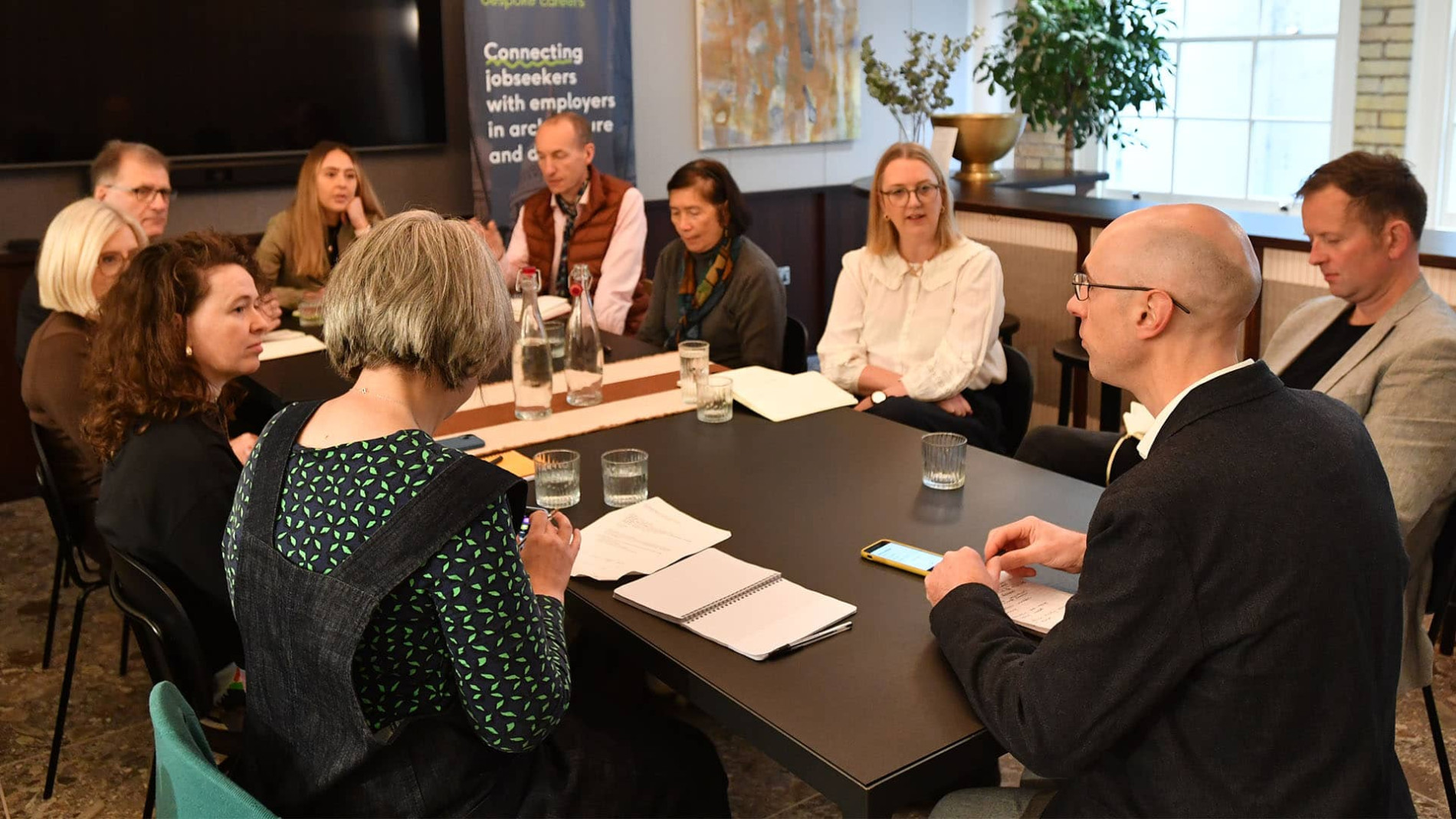
A panel of experts discussed how best to manage the recruitment process in a fast-changing market.
Looking for insights into architecture salaries and design salaries in 2024? Our CEO and founder, Lindsay Urquhart, shares her thoughts on the global architecture and design market for 2024, and what to expect as the year unfolds.
A conversation with the co founder of New London Architecture and the London Festival of Architecture on careers that bridge media, practice and city making.