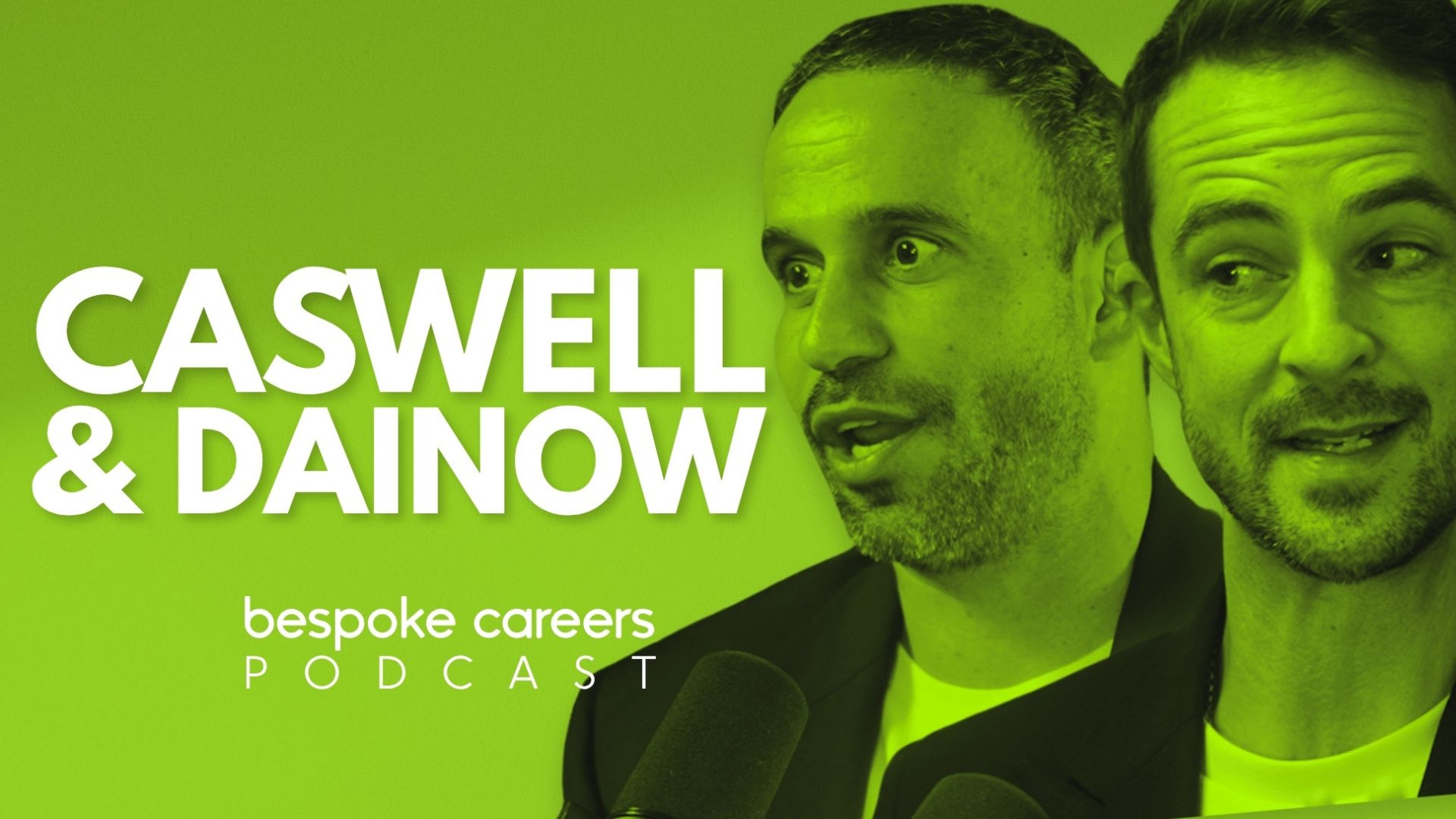
Why We QUIT Architecture (and Never Looked Back!) – Caswell & Dainow
Former architects Charlie Caswell and Adam Dainow discuss transitioning into property development, the necessity of relinquishing design control, and the five-year grind of building a business from the ground up.
Charlie Caswell and Adam Dainow are the founders of Caswell&Dainow, a design-led property developer specialising in complex, small-scale residential sites across London and the South of England. Both trained as architects, meeting at the University of Sheffield before going on to run studios at established practices. In 2017, they swapped the drawing board for the deal sheet, bringing an architect’s eye for design to the overlooked plots and knotty constraints that most developers walk past.
In this conversation with Bespoke Careers, Charlie and Adam talk openly about what they gave up, what they gained, and what architects can learn from the other side of the table. They discuss the five-year grind of building a business from scratch, how their friendship became a partnership, the “toilet test” for finding your passion, and why they believe architecture education needs to change.
From Architects to Developers
 Bespoke Careers (Chris Simmons)
Charlie, Adam, thank you so much for coming. Thinking about architecture and you becoming developers. What did you have to give up from being architects to become developers?
 Adam Dainow
It’s a good question actually. When you’ve got to let go of a few things. When you’re in the architecture business, it’s very much about “this is our idea, this is all ours.” When you become a developer, you’ve got to take a step back and let people breathe, let them do what they do, and you become more of a curator over designers. As an architect, your brand is everything. “That’s our building, that’s our story.” And actually when you become a developer, is it your building? It is. But is it the architect’s building? Yeah, it is. And you’re less precious about it.
 Charlie Caswell
What perhaps helped us was that we’d both been directing studios beforehand. So the reality of that ownership over the architecture, we’d got to the point where it’s not us anymore, it’s not our idea. For me, it was a relatively natural transition. Under our employment, we’re bringing in other architects to work on our projects. We have a curatorial role, but we’d already let go of that sense of ownership.
Adam DainowIt is something interesting on the business side, because when we started off as developers, early on, we were doing the design in-house. We couldn’t afford to pay other architects. That’s the reality of it. But there was definitely a transition point where we said, actually, we’re not going to do it in-house, we’ve got to use external architects. And that was an interesting point in the business because it was something me and Charlie disagreed on. It was actually Charlie’s idea to say we should employ architects. I was always a bit nervous at the start because I thought, this is us, it’s our business. We’re giving away some of ourselves. And actually over time, once we did it, it’s the thing we enjoy the most. And it’s what’s helped our business really grow.
Charlie CaswellThere are a lot of architects who develop. And what we’ve become quite firm on is the fact that we are now developers who used to be architects. As soon as there is the opportunity to be distracted by the drawing package or that design project, it really eats away at your ability to focus on development as a business. All our time and energy is focused on development and we are not distracted by the architecture. We have set design team meetings, and other people are doing the all-nighters beforehand, but we don’t get drawn into that. That’s been one of the fundamental differentiating factors about people that do similar things to what we do.
Meeting at Architecture School
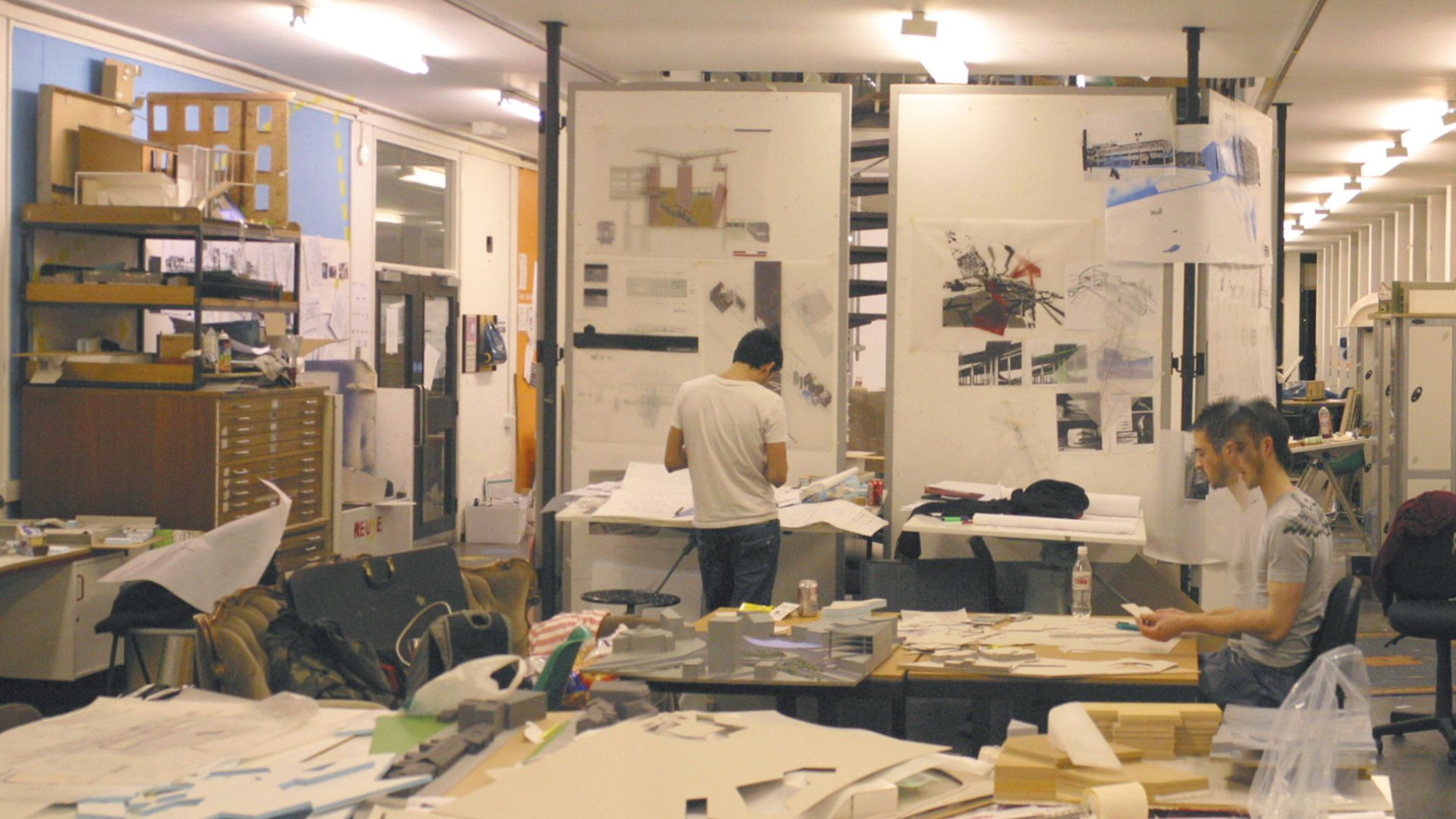
Bespoke Careers (Chris Simmons)Let’s go back to the beginning. You two met at architecture school in Sheffield. Was there something that you noticed in terms of your complementary skills? When people talk about going into business with each other, it’s about this person has this skill set, this person has a complementary one. Did you notice anything about each other at that point?
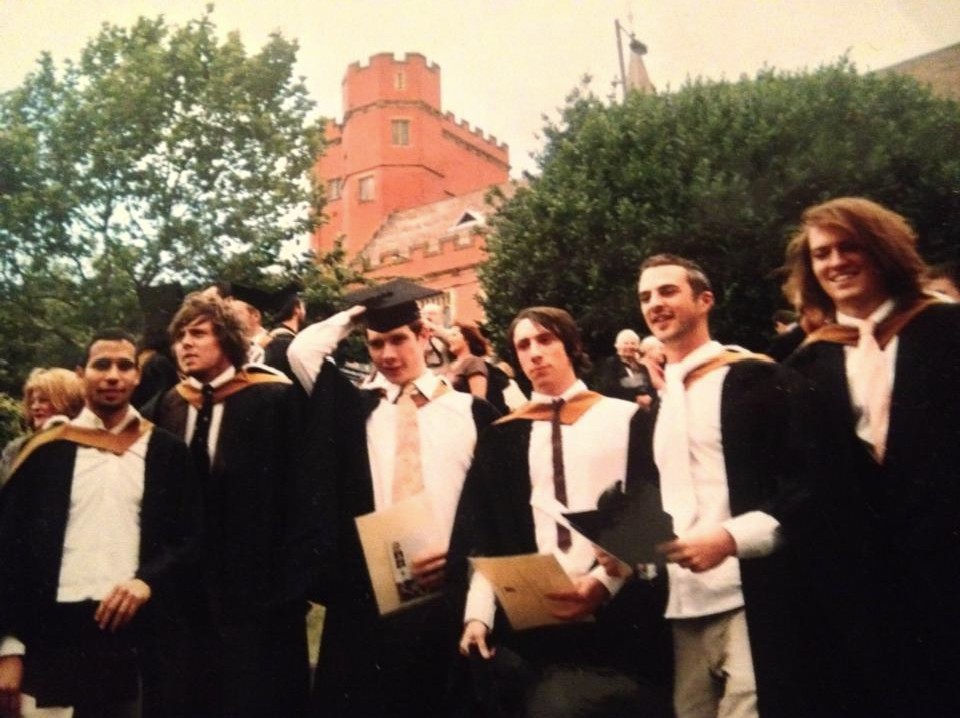
Charlie CaswellIt was too far off in the future. We were always mates. We met at undergrad at Sheffield University. We were good mates through that period. We left Sheffield, lived with each other in Manchester for a year, then a group of us went down to London. There was no point during that where we were like, “oh, we should run a business together.” The point at which we could tell that we were wired slightly differently to other people was probably when we came back to Sheffield for the Masters and we were like, “oh, we should try and buy a property up in Sheffield.” It wasn’t “we should do it together.” It was just we both had that instinct. Adam bought a house next to the Arts Tower. I bought one on the edge of the Peak District. It was quite a cathartic process, learning on the job, making mistakes. That was the first time we understood maybe we were the type of people that wanted to make things happen.
Adam DainowThe key is we were friends first. Having that friendship and trust, going on holidays together, really getting to know somebody’s psyche is so key when having a business partner. Because when you’re dealing with big chunks of money, there has to be trust. Charlie can vouch for me, trust me with the bank account, and vice versa. There’s trust in money, but there’s also trust in work ethic. When you’re in architecture, you really see how someone works, are they lazy, what’s the design effort? Often people go into business and they’ve never seen people in that instance. We’ve seen each other through all-nighters in the studio, that real grinding out. Architecture school is a real grind. When you’ve seen that in someone, it really helps when you go into business.
“
When you’re in the architecture business, it’s very much about ‘this is our idea, this is all ours.’ When you become a developer, you become more of a curator over designers.
Climbing the Ladder and Knowing When to Step Off
Bespoke Careers (Chris Simmons)You mentioned about your roles moving up in your practices, both of you moved into management quite early on in your careers. What was it about that that unveiled the wider picture of architecture and development?
Charlie CaswellWe’ve both been really fortunate in our careers to have a really varied experience. A lot of people get to a stage where they’re climbing up, and it’s quite evident, you’ve got two routes. You either want to be creative director or you want to be managing director. An operational role or a creative role. For me, I always enjoyed an Excel spreadsheet just as much as I enjoyed a drawing pack. So I gravitated more towards management. And for both Adam and I, we always had a hand up, if there’s something to do, we would do it. Perhaps we were both comfortable slightly outside of our depths, taking on responsibility.
Adam DainowFor me in architecture, I always got itchy feet. I’d work somewhere for three years, then I’d want to go somewhere else. I’ve learned so much from all my different directors. I’ve probably worked at four different practices. I was always quite close to them, always wanted to learn from them as much as possible. But I also got to a point where Charlie became more senior in his practice than I was, as an associate director, which was great. But there’s a moment where you look at your bosses and think, is that a job I want to do? And if the answer’s no, you’ve got to step out. We always wanted to be our own bosses, always wanted to get into property. And you’ve just got to take a risk and do whatever that thing is you want to do.
The Toilet Test
Charlie CaswellWe’ve got different versions of saying that. Adam’s is the train test, mine’s the toilet test. You can assess what your passion is. When you’ve got time to yourself, sitting on a train or sitting on the toilet, what are you looking at on Instagram? For me it was never super prime interiors. It was always lock-up garages in Croydon and stuff like that. That was the acid test of what gets you going, what fires you up.
Adam DainowWhat do you do when you’re not getting paid to do anything else? For me it would always be interesting property and small stuff. Even at university, my favourite issue of the Detail was always small projects. I was never interested in the tower or the big building, but the small, the nitty gritty. I find it fascinating, how to get good design from those sites.
When the Side Hustle Became the Business
Bespoke Careers (Chris Simmons)You mentioned buying property at university and getting into it that way. When did it stop being a hobby? How much of this stuff did you need to do before you went, actually, this is a business?
Adam DainowIn reality, you probably need a lot more. That’s the truth, right? But if you wait till you’ve got too much experience, it’s too late. We had to have a discussion between us that we want to do this business. One of us needed to get out of architecture. And at the time, I said, look, I’ll do it. I’ll get out of my job. Charlie was a bit more settled in what he was doing, and I took a pay cut to do that. I was just itching to go. In hindsight, we thought we knew more than we did. You’ve done a couple of refurbs. You’re young. You’re optimistic. It’s a pretty steep learning curve. And when you’re in it, you’re like, wow, the plan doesn’t go to plan. That’s the reality of it.
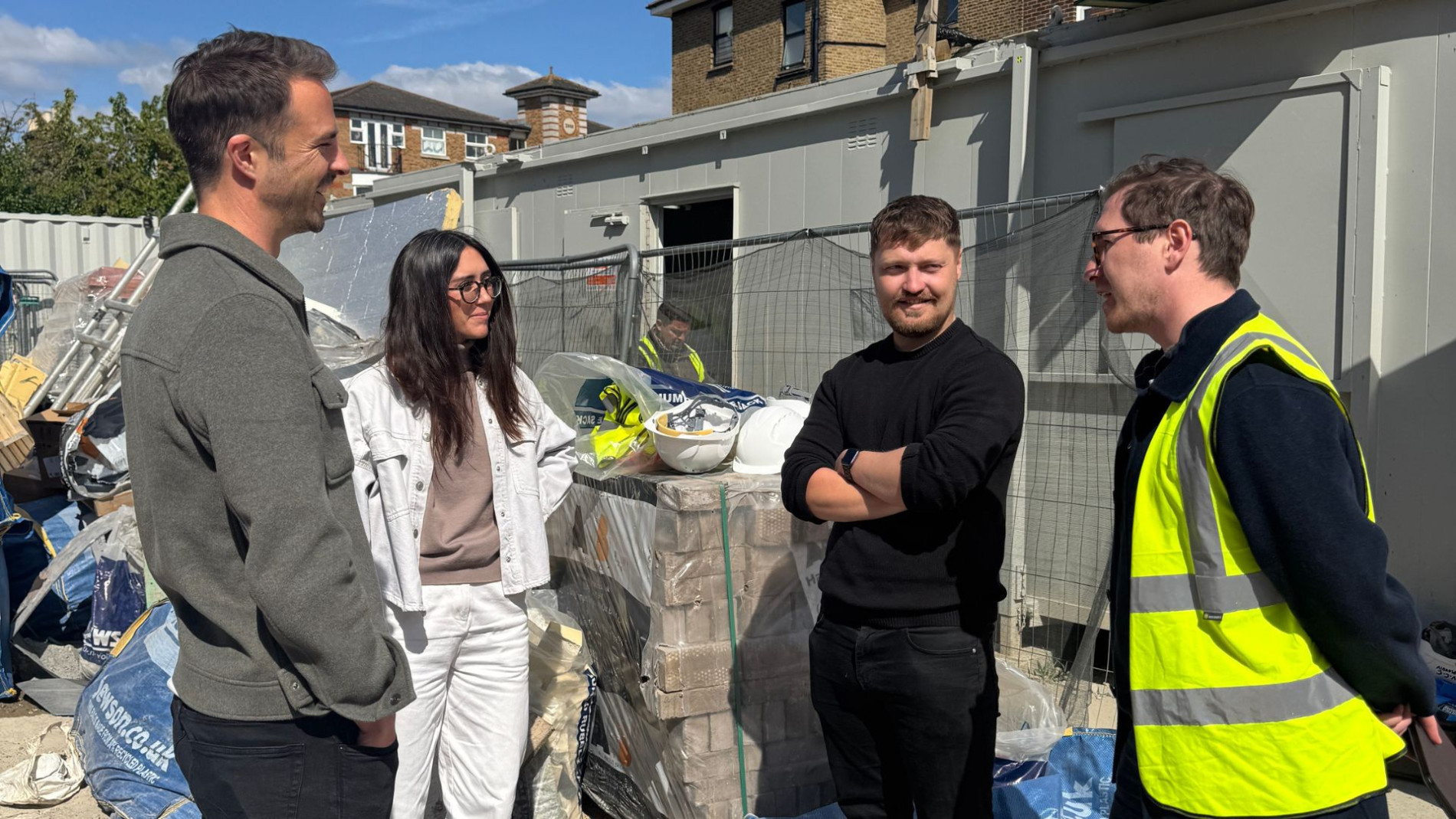
Charlie CaswellWhen we’d been doing projects on the side, we had our careers. This was our hobby. It was our side hustle. Like a lot of people, the advice is don’t quit your job if you haven’t proven it already. We’d been doing this as a side hustle and Adam was the one that said, okay, we’re in different situations. I had kids and stuff like that. Because Adam lived in a house that he owned, he could strip right back to student mode, baked beans on toast, and effectively grind for five years. There is no property development school. Adam had to go and kiss lots of frogs and learn the hard way and grind away for those five years to build the business to a point where it made logical sense for two of us to be in it.
They were difficult years. Adam was doing it by himself. I was doing a job and trying to interact as best I could. But it was very much that test of, how much do you want it? How much are you willing to sacrifice for it?
Adam DainowThe first few years, we had these business plans of how success was going to be. We spent loads of time on branding early on, getting obsessive about business cards, and then nothing goes to plan. But the grinding is a real grind. What was quite good is that Charlie was working full time. Every week we’d still meet. Charlie would meet me on an evening or an early breakfast meeting before his full-time job. I was running around a bit like a headless chicken with all these ideas, and Charlie was often the voice of reason. Even though Charlie had a full-time job, he was always massively involved.
It is trial and error, to be honest. You don’t know what you don’t know. But what we always figured out was networking. Going out there, meeting developers, learning from them, understanding what you’re good at, what you’re not good at. Eventually you get to a point which became land, and that became the business. But it wasn’t the business we set out to build. We thought we were going to be refurbishing houses or converting houses to flats, maybe new-build.
We learned the hard way. Nearly running out of money here and there. Stressful. Things go wrong. You lose money. But the key was this determination, this is going to work. There’s a bit of ego in the first couple of years. All your mates are rising in their architecture careers. And you scrap around. It’s also a bit embarrassing, right? You can’t fail because your friends are going to go, “I told you so.” So there’s just this drive, we’ve got to make this work. There’s a belief and a vision. And I always tell people, it will happen. You’ve just got to believe in yourself and keep going.
“
The toilet test. When you’ve got time to yourself, what are you looking at on Instagram? For me it was never super prime interiors. It was always lock-up garages in Croydon.
Two Minds Better Than One
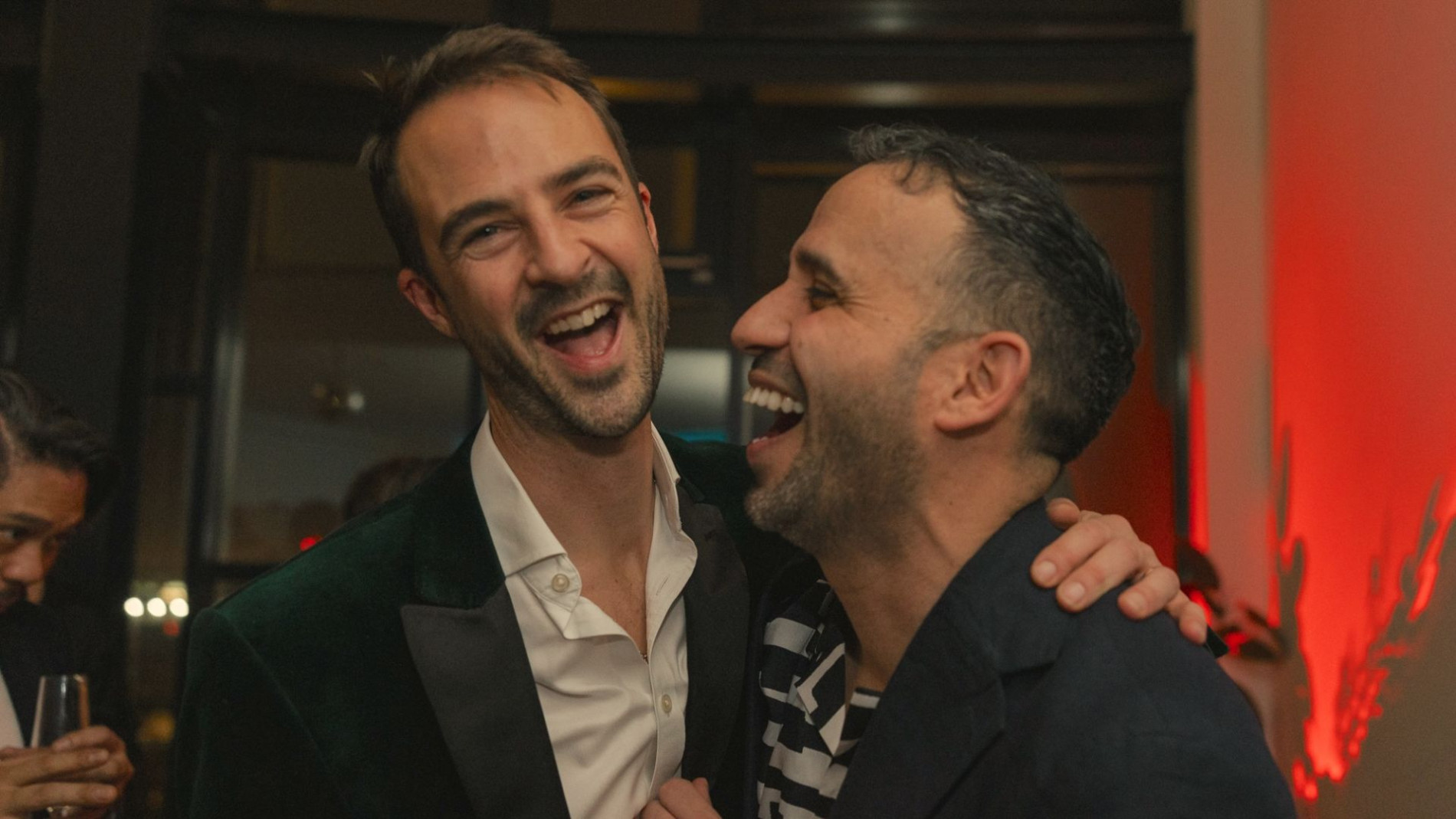
Adam DainowTwo minds are better than one. We both have different ideas, but sometimes you need a voice of reason.
Charlie CaswellIt was less about us identifying commonalities and more about each of us understanding the skills the other had, which were mutually complementary. Adam is instinctively more entrepreneurial than I am. He sets the direction. Whereas I’m naturally more operationally minded. So I’ll figure out how to get there. We like the bits that the other perhaps doesn’t, and when we come together it’s like a jigsaw puzzle, it just clicks together and works.
Adam DainowWhen I got the business to a point where we could have two director salaries, I said I need Charlie in the business, because it was a bit scrappy. I knew Charlie was going to bring so much rigour to the business. It’s what we needed to get to the next level, and it massively changed things. But I also remember having a conversation with Charlie saying, “you’re going to love this.” Because Charlie had to take a risk on a good salary, pensions, all that jazz. And I was like, look, it’s not about the money side. You wait until you’re your own boss and every day you get to do what you love. It’s a game changer. I can’t explain how much your quality of life improves. Every day, the stuff I hated, Charlie’s great at. And vice versa. Every day you just try and do what you love. It’s a great place to be.
Complex Sites and the Architectural Edge
Bespoke Careers (Chris Simmons)Let’s think about the work itself. You’ve landed on this idea of complex sites, looking at these things as an architect looks at a design challenge, trying to solve it on these small sites. What is it that you take out of these types of things? Is it just about opportunity, or is it about the design?
Charlie CaswellJust to give a bit of context, when we started the business, it’s not that we were naturally drawn to these complex, knotty things. The reality is it was all we could afford. You go down to the bottom of the list, what’s the cheapest, what’s no one else going to touch? And that’s basically what we had to focus on. We sharpened our teeth on these really complex ones, and our architectural background helped, we had a slight head start in understanding it. But the beauty of these things is that they very much shape themselves. We now see the constraints as opportunities. Once you’ve factored in all of those constraints, the building fixes itself. Design is that very last bit, the dress on the envelope, rather than coming in with this fresh new idea and applying it to a site.
Bespoke Careers (Chris Simmons)So what do you think you see that others don’t?
Adam DainowWe’ve got the ability to look at opportunity. To be a good developer, you’ve got to be looking at the glass half full and be able to understand the constraints. In my mind, it’s like modelling a piece of clay, once you’ve taken off the pieces, once you’ve modelled all the constraints, you know what that building is. You can sit there and through experience understand the parameters and then have that shape in your head that makes a viable building. That’s where the experience of development comes in.
It’s a gut feeling. We see hundreds of plots of land, actually nearly thousands. And what architecture does is give you a knowledge base. As soon as you’re looking at it, your reference points, all the other projects you’ve seen, what you’ve worked on, planning policy, rights of light, what you can do with massing, you can have a vision, even if you don’t know exactly what it’s going to look like. That just really gives you an edge over other people.
But it’s also working to your advantage. Development is pretty tough out there. We’ve got to work to our strengths, and our strengths are the tricky sites, how do we unlock land? Partnering with great architects, choosing the right practice for the site is key. Sometimes you see development sites and they haven’t chosen a bad architect, they’ve just chosen the wrong architect for that site, the wrong consultant team. That’s what we’re quite good at. We’re like a producer or a director, putting the best people together.
Project Spotlight
Pellatt Road, Wembley – 13 Apartments
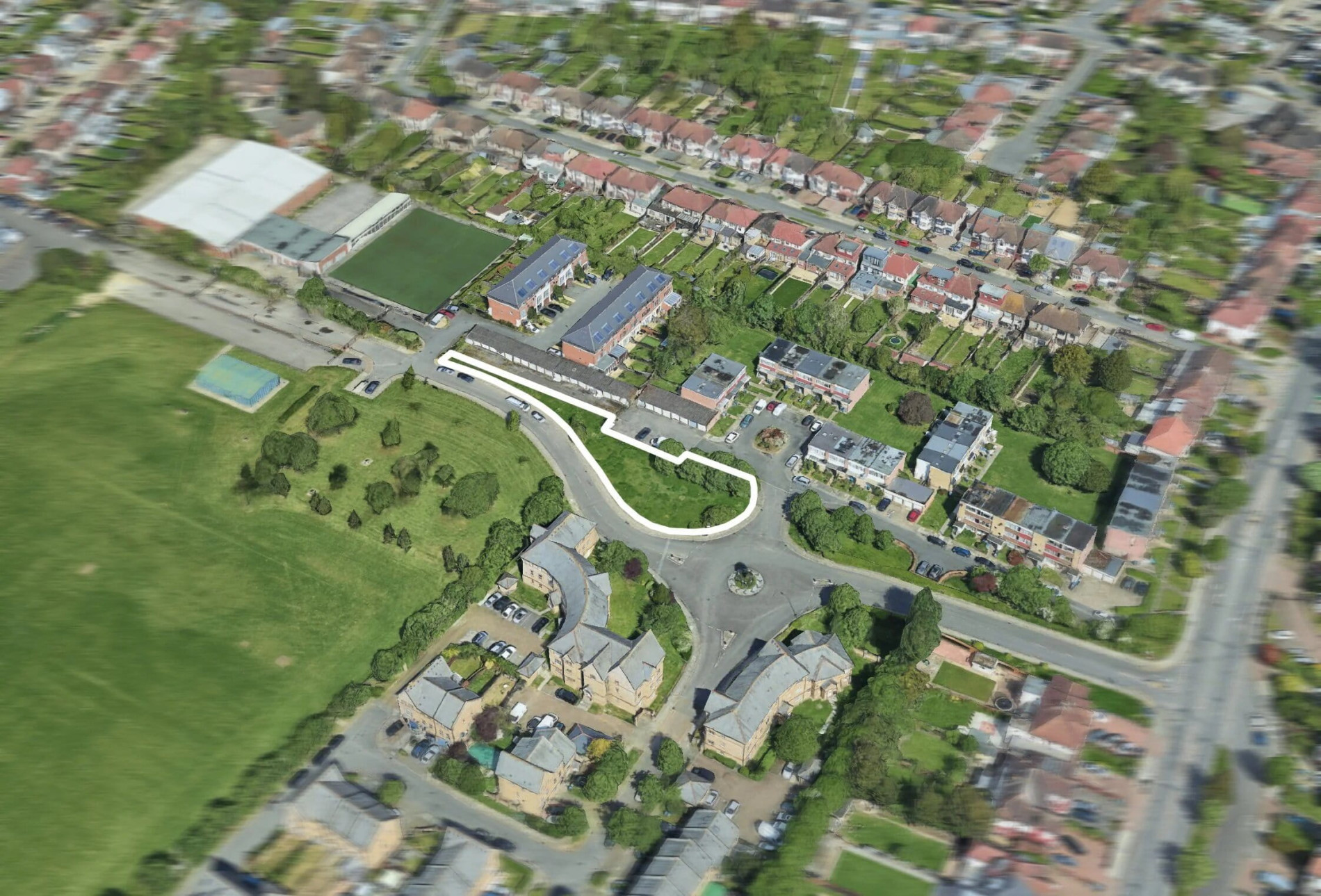
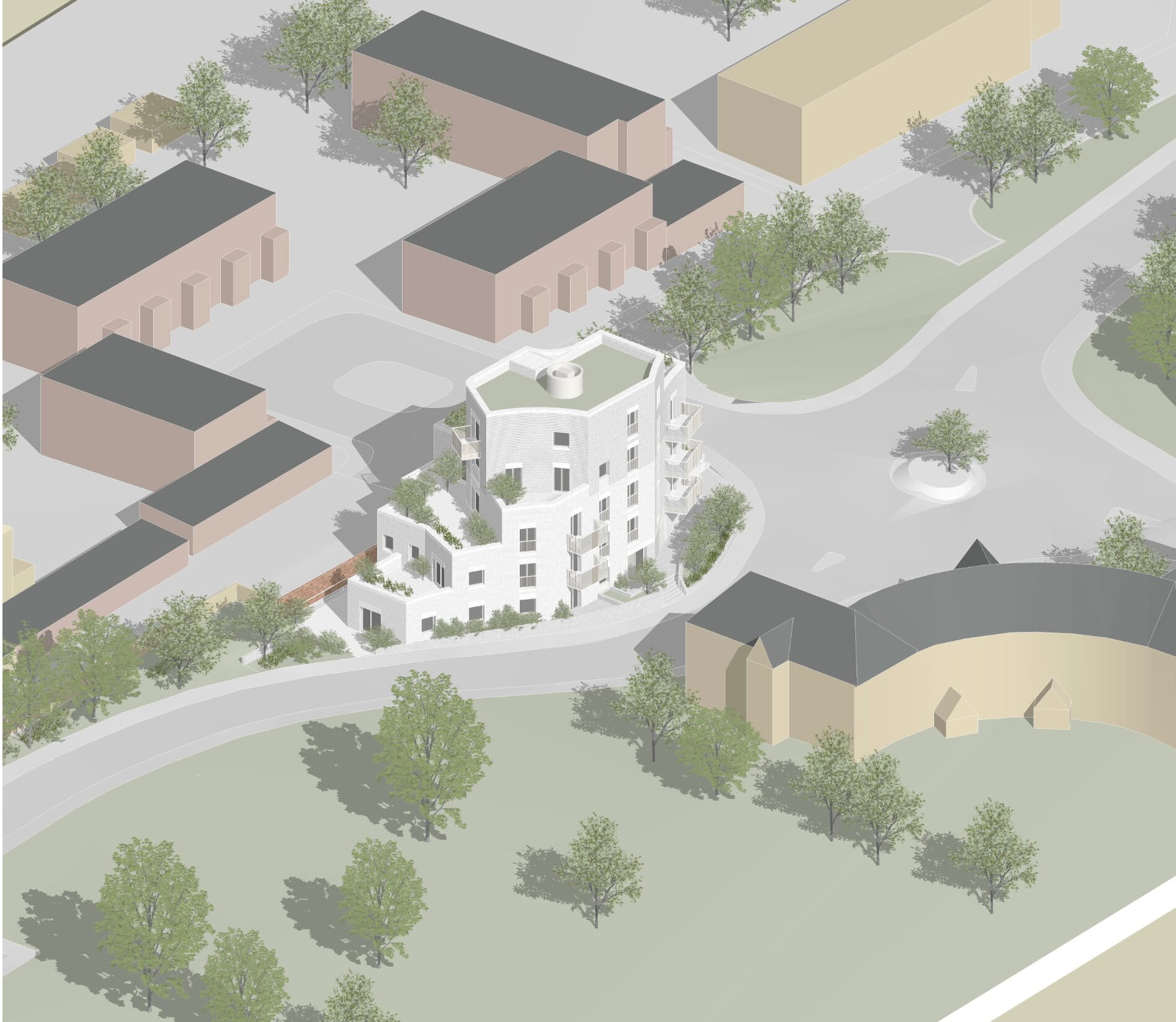
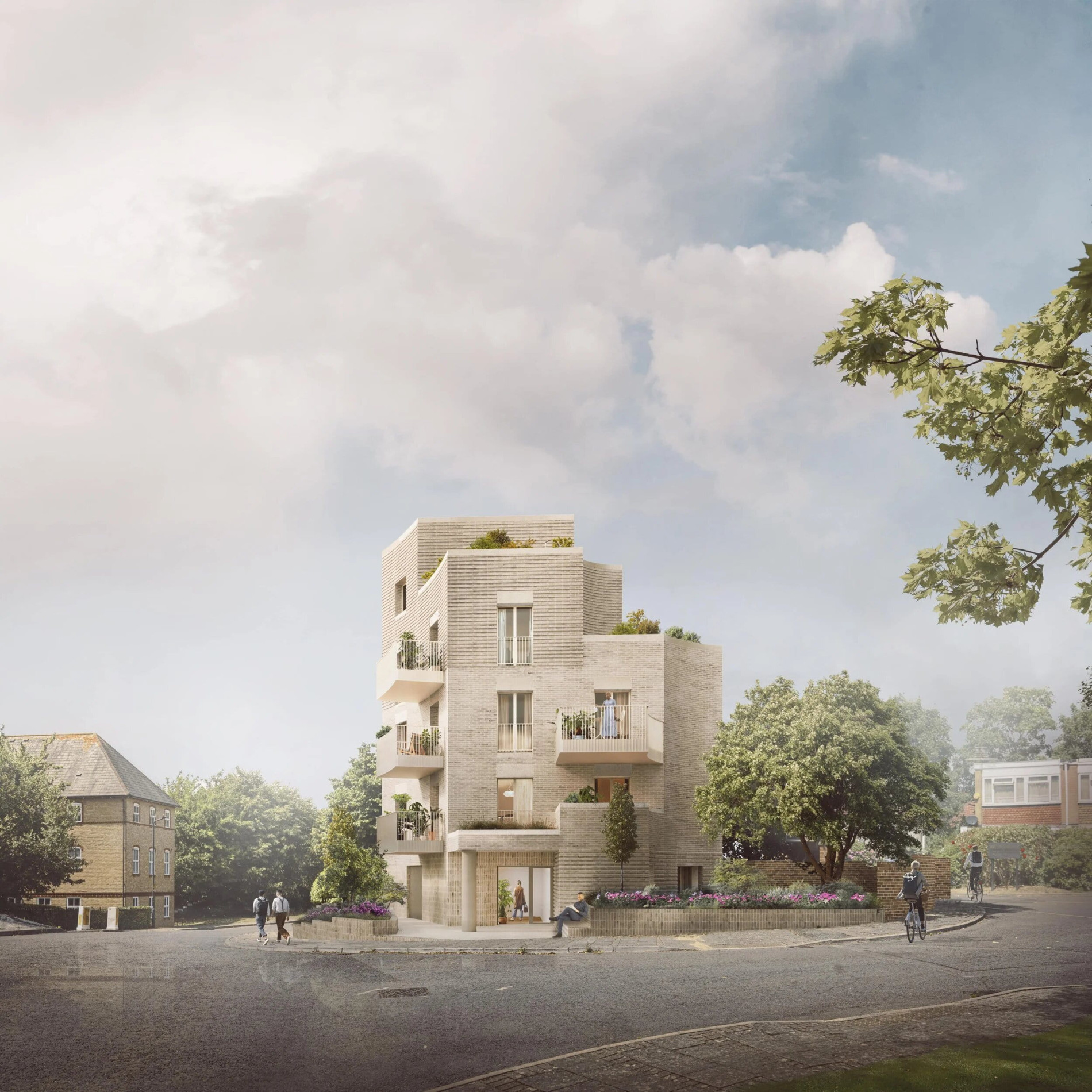
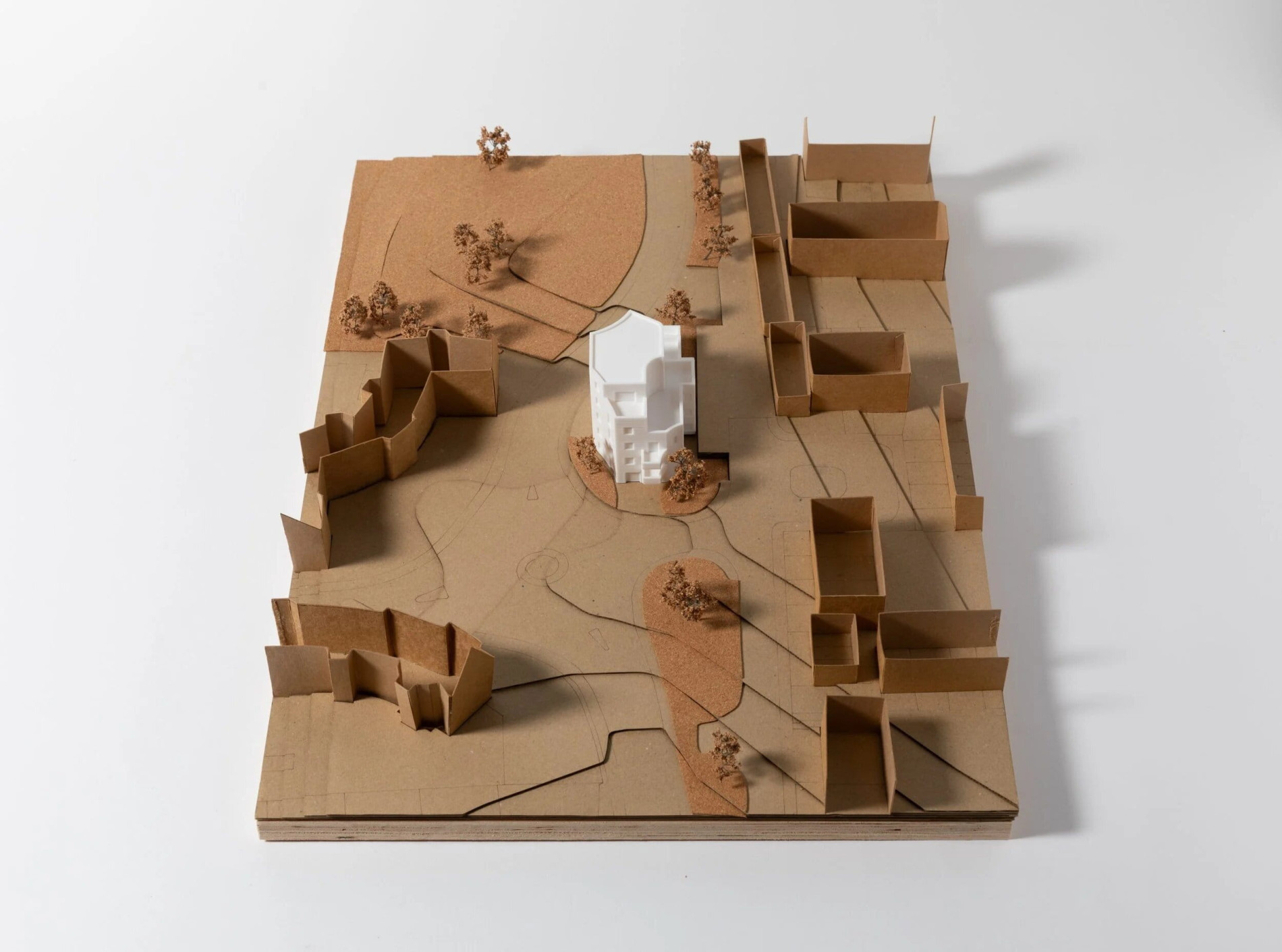
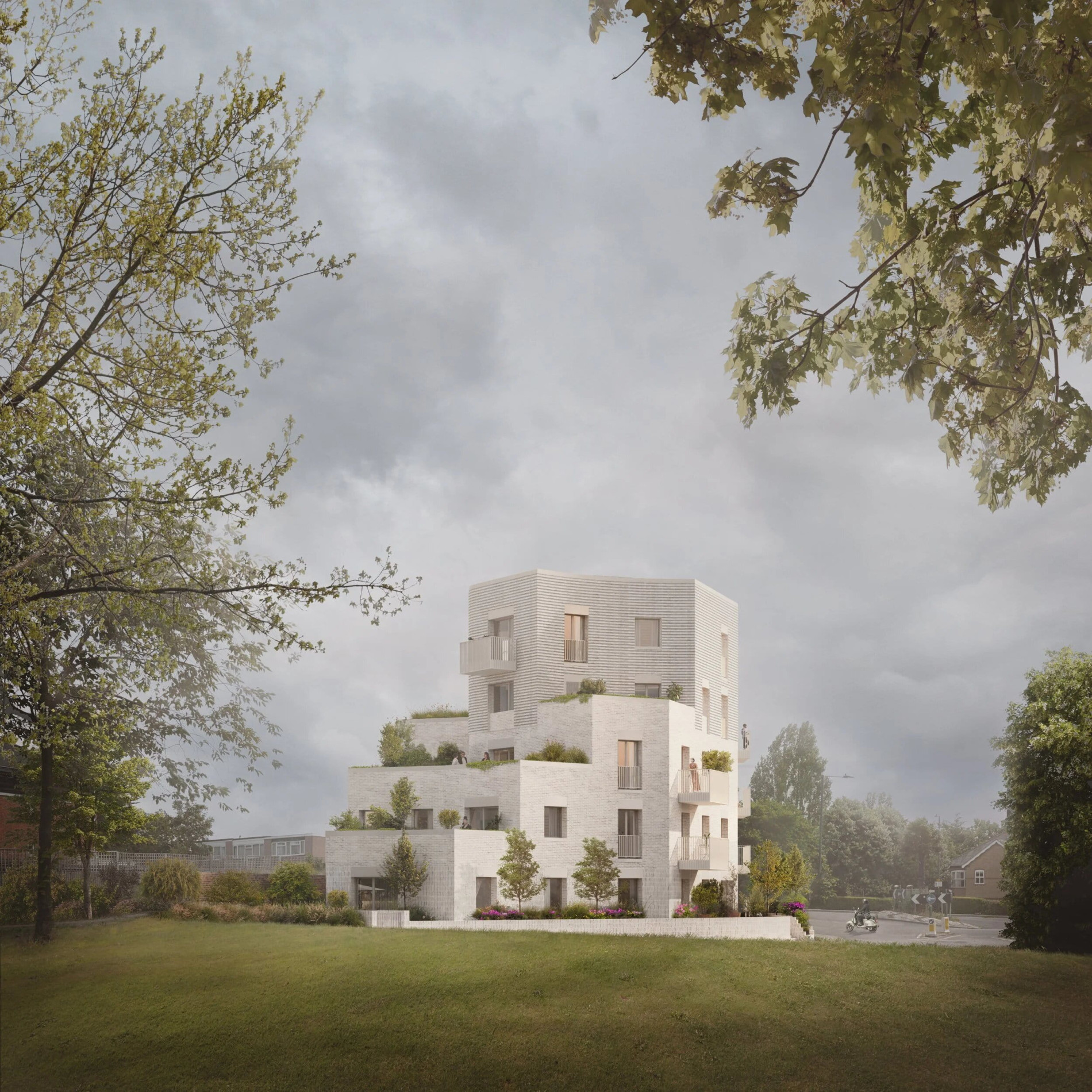
Caswell&Dainow negotiated the purchase of this overlooked piece of land from a large UK housebuilder. The 1,009m² site sat on the north-western corner of a roundabout opposite Preston Road Sports Ground, under-utilised, but in a fantastic location next to a large park in Wembley.
Working with architectural practice GPAD and planning consultant MJP, the building is designed as an extension of the park, with oversized planted terraces stepping up the building for the new residents to enjoy. The 13 apartments, a mix of one, two and three bedrooms, all dual aspect, sit within a chalky, monolithic form that is carefully carved and sculpted. White/buff brick in stretcher bond with flush light mortar references the bold modernist buildings in Wembley’s history, while creating a neutral canvas on which the generous planting of the ground floor and terraces can be emphasised.
“This overlooked plot was part of the extensive portfolio of a national housebuilder, which Caswell&Dainow was asked to analyse. After reviewing a number of opportunities to find untapped potential, we purchased the Pellatt Road site having faith that great design could breathe new life into what was an unassuming grassy edge to an existing housing development.” – Charlie Caswell & Adam Dainow
Landscape proposals by Match Landscape aim to create a vibrant and sustainable setting, with terraces and roofs creating verdant tiers ascending the building to enhance biodiversity. The reinstatement of a historic hedgerow through the planting of 42 new trees maximises the site’s green credentials to attain a 10% biodiversity enhancement.
Charlie CaswellOne of our mottos is “every day is a school day.” And we genuinely believe that. We’re probably good at this because it’s all we do, all day, every day. And the more we do, the sharper we get. Every year when we look at our projects, they are getting better and better because our filter is getting finer and finer.
Adam DainowIt’s interesting, because we love seeing other people’s projects. We’re pretty pally with some really great developers out there. What’s quite nice about development is it’s quite open. In architecture, sometimes practices are a little bit closed off and everyone puts on a big smiley face. In development, we often go for lunches and coffees and we’re pretty honest about what’s going well. We share knowledge about planning and architects and policy. We also go and see a lot of buildings, we love going to see how other people have done sites.
“
I no longer believed in the architectural model. The thing about development is you are rewarded by the value that you add rather than the time that you take.
What Kind of Clients Are You?
Bespoke Careers (Chris Simmons)With that in mind, what do you think you’re like as clients, and as bosses?
Charlie CaswellWe’ve been on the other side of the table. We have a natural sensitivity to what makes good clients and bad clients. Fundamentally, we do small, intricate sites, the type of things that probably interest architects, but we’re probably less likely to be the biggest fee in these companies. We know that. We’re happy with that. But we want maximum attention. One thing we zoomed into really easily was, if you can’t pay the biggest, pay the fastest. We understand that business is tough out there for the architectural community. You want to spend your time designing, not chasing invoices. That’s what we want to be known for, finding young talent, giving them a springboard to create these new buildings, leveraging whatever PR or notoriety we have to put their name forward, not trying to over-brand it, and then rewarding really fairly, on time. So people are motivated to work for us.
Adam DainowThere’s a common theme in all our projects. They’re all under fifteen homes. The biggest practices we work with probably have twenty to twenty-five staff, the smallest is a single person, but they’re all very design-focused practices. And it’s a personality thing. We’ve got to be able to get on with them. We can’t just be some project in your office that someone does. You’ve got to be passionate about this.
We understand how much work goes behind the fee. Often, typical developers might not realise that an architect has drawn fifty-odd options. We understand how long drawings take to make. We always want to pay fairly, pay good fees, pay on time. And if someone’s done stuff outside the fee, we’re happy to pay for that. The architects we work with, they’re passionate as well. That’s probably the common theme.
As clients, sometimes we’ve probably got the pencil a little too much. If I’m being honest, we have to learn sometimes to give people space. Sometimes we put a few too many sketches over things. But the older we get, the better we are at giving people space to do their thing.
The Business Model. Why Not Build?
Bespoke Careers (Chris Simmons)Obviously your business model works on purchasing land or going into joint ventures, gaining planning, and then selling the sites on for other people to build. As an architect, the dream is to build everything. How have you come to accept that as the business model?
Charlie CaswellFor me personally, one of the key motivations about setting up the business was I got to the point where I no longer believed in the architectural model. I’m running a practice, I want to make more money, I need to win more projects, I’ve got more projects, I need to hire more people, got more people, I need a bigger office and a bigger server room, and now the costs go up. You’re stuck in this cycle where the only way to make more money is to take on more problems. The thing about development is you are rewarded in a fundamentally different way, you are rewarded by the value that you add rather than the time that you take. That’s why I believed fundamentally in the transition.
Our model focuses on finding the land, being proactive, going out there, meeting landowners. When we started, Adam and I would just be staring at garages and gardens and pinning them on our phones. As the business has evolved, so has the sophistication of that, to the point where we’ve got maybe 30,000 sites in the database now. Our time is spent nurturing those conversations with landowners. We’re spending 50 grand a year on stamps at the moment just trying to go out and meet people.
Adam DainowYou have to look yourself in the mirror and go, will we be the best people at building? We haven’t got in-house contractors, in-house builders. We’re not a firm that’s built out ten of the same small sites where we know exactly the best brick to use and the best groundworks company. Planning is so complicated now. There’s so much rigour to it. We want to become experts in that. And if you wear too many hats in property development, you’re going to get burned. The people who build out, they’re really experts at it, and that’s where they make their value.
You’ve got to choose a lane. It’s an ecosystem. We want someone else to build it out, but we want to be involved in that process, what’s that detail, how should we do this kitchen. We go to the sites all the time. We want them to make money. They buy the sites off us.
There’s also a reality that architects don’t always see behind the scenes. When architects see the project, they see it starting from the day that first sketch hits paper. That piece of land, we might have been negotiating for a year or two years. Sometimes developers get a bad name because there’s a lot of pressure on the architects, but the developer spent years trying to buy that piece of land. Sometimes you get to a point in the planning and you’re sick of that project. You’ve had it for three or four years, can’t wait to move on to the next one. But you still want to see it built out well.
Charlie CaswellWhen we set up the business together, we spent time just being like, what do we like doing? What do we not like doing? How do you make sure you wake up each morning doing exactly what you want to do? Quite early on we were like, well, we don’t want the hassle of an office and the server and everything like that. So we won’t have an office, we’ll keep everything on the cloud. That simplicity, we really tried to bring it all the way through. We take it up to planning, we can manage that process. If you want to take it beyond that, building is expensive. You’re going to take on debt and then you’re locked into that project.
A lot of it was that mindset of the lean startup, keeping agile, not locking yourself in and putting all eggs in one basket, then finding that the market shifts and you’ve got no control. It’s a risk mitigation strategy as well. Never say never. Each time we look at a project, we’re taking a very cold, hard look at, is this the right decision now? And so far, every time we’re like, yeah, that money goes back in the business. Let’s do more projects.
“
If you can’t pay the biggest, pay the fastest. We understand that business is tough out there for the architectural community. You want to spend your time designing, not chasing invoices.
Managing Risk
Bespoke Careers (Chris Simmons)Do you ever worry about risk? Is there a cycle of that?
Adam DainowBeing nimble is so key. We never wanted an office. We try and minimise overheads. We work from restaurants and cafés, or going to see sites, or in the car. Because every month, cash flow is a nightmare. Often we have to rethink what we thought was going to happen. It’s about being really creative. There’s always a solution. There’s always something. But you’ve just got to believe in yourself.
Building the Brand
Bespoke Careers (Chris Simmons)You guys seemingly have a really great presence, a clear identity that’s obviously incredibly intentional. How much time and effort have you put into that?
Charlie CaswellThat goes back to learning from architecture. The last practice I worked for was a company that did architecture, interiors and branding, which is quite unusual. I was in all the branding meetings, making decisions, listening in to how branding works for super high-end retail, trendy brands, restaurants. From that I really understood messaging. What you put out there is how you define yourself. It’s not just about colours and fonts. It’s about the story and the personality.
Sometimes you go and meet a developer or an architect and their website looks like something fabulous. But when you meet them, they’re nothing like that. It’s such a disconnect. It’s a loss of trust. For us, we love design but we also like to have fun. We’re not a corporate structure. We always wanted to be open and share stuff. Our Instagram is really important to the business. We always try and put the architecture we work with at the foreground. It’s not just about us. It’s about promoting architects.
Adam DainowOften you look at developers’ websites and there’s literally no architecture on there. It’s almost like it’s hidden away. For us it’s the opposite, putting architecture out front. That ecosystem helps our brand.
But another important aspect is that the majority of our work is going to come from landowners. John and Jane down the road, who don’t read Wallpaper magazine. We’re always trying to put the language we use in a very matter-of-fact way. Not overkill what we’re doing. Portraying our characters. Because for people who aren’t experts in property, working with a developer can seem a little bit scary. We’re very much trying to put a person’s face on it. Like, look, this is okay, we’re the experts, we’re going to hold your hand through this. Put it in very non-architectural language. Be quite matter of fact.
Because archi-speak, it’s bullshit, honestly. It’s like a closed club. If you didn’t study architecture for seven years, you’re not going to understand it. When you look at how architecture is written about, it’s so closed off. We’ve always wanted to make sure when we talk about our projects or our land, it’s accessible. I read a quote that said you should be able to explain anything to an eight-year-old. If they can’t understand it, it’s on you, you’re explaining it wrong. Architecture needs to take that on board. It can be great design, but it should be accessible.
“
Archi-speak, it’s bullshit, honestly. It’s like a closed club. You should be able to explain anything to an eight-year-old. If they can’t understand it, it’s on you.
Giving Back to Architecture
Bespoke Careers (Chris Simmons)You regularly post things about how architects should present to developers, how architecture students can put themselves out there. Is that an attempt to produce more developers, or to improve the industry, a wake-up call?
Adam DainowIt’s a natural thing. We meet lots of architects and we love doing it. Architects are sometimes brilliant at what they do, but sometimes they’re not the best at presenting their ideas. Sometimes we meet architects or people setting up a practice and they think they’re going to come to us and we’ll just give them a project. But sometimes if we don’t find the right fit, we want to give something back. It becomes a bit like tutoring.
Often architects will come to us, show their portfolio and say, “I really want to do what you do, we don’t get the land.” And I’m like, okay, but you’ve just shown me something amazing in your portfolio. Do more of that, because I don’t know any other architects doing that. For us it’s about meeting architects. It’s not always about winning work for ourselves, but sometimes about curating what could be good for them.
The Future of Architecture Education
Bespoke Careers (Chris Simmons)Do you think there is an opportunity for more architects to be doing what you do?
Adam DainowDefinitely. My dissertation at undergrad was on the developer, mind you, it wasn’t a good dissertation. Don’t ever try and read it. It’s got a good front cover to it. But going back to architecture school, there’s often this “us and them” mentality. And it’s like, guys, these are the people paying the fees, right? So the more architects get into development, the better.
But the problem is architecture education is so long. It’s quite hard sometimes to step out when you’ve just spent seven years learning this one thing. We’re quite big believers that architecture education has to change. I don’t think it works, how long it takes. Part of that is being more entrepreneurial. Architecture education needs to expose people to business and costs and land and buildings, working with developers, how to win work, how to run a business. The new wave of architects coming out, they can’t just do a typical practice doing extensions or small buildings. You’ve got to wear a few hats these days to create a successful business.
Charlie CaswellThere’s a common theme, a developer or a landowner says, “can you do a feasibility?” and an architect does all this work, gets the planning application to a point, and then nothing ever happens. So much wasted time. If architects can get taught at university more about the economics of buildings and land, the whole ecosystem just becomes better. Buildings become better when there’s real rigour about how that financial model works.
We were fortunate, the places in Sheffield, the lessons that we learned, we learned very early and very cheaply. We did that in 2007, 2008. Zero percent mortgages. Scraped together our student loan, bought a house with it. That has been invaluable. We’ve made evermore expensive mistakes going forward, but it taught us really early on that development is not a get-rich-quick scheme.
I could do a whole podcast just about architecture education versus what we did and didn’t learn. The fact that running a business, charging for work, understanding your value isn’t front and centre with what you’re doing, you get distracted by the value of creativity, which is getting evermore eroded by AI, with options being splurged out left, right and centre. There’s absolutely still a role and a value for architecture, but it’s not in that classic “are you the most creative, can you create the most beautiful drawing?” That product-over-process fetish that’s still there within the industry is pulling it in the wrong direction. We’ve got to be focused on problem-solving, listening, understanding what the problems are and finding creative solutions, rather than trying to zoom straight to the end and create something beautiful.
What’s Next?
Bespoke Careers (Chris Simmons)Coming to the end now, what’s next for the business? Is it about growth, is it about scale, or is it about doing more in different places?
Adam DainowWe love just trying different things. What we’ve realised is sometimes people say, “oh, move on to a bigger project, a big build.” But we fit in the zero to twenty houses at that scale. It’s all about design. As soon as you start getting to fifty or a hundred, it becomes a numbers game. For us, we don’t want to do bigger. We want to do more. We love working in new areas. We work outside of London now. Bath, Bristol, all these other places. For us it’s super exciting, learning about a new area. We just want to get better at what we do, find more brilliant architects, and do more of what we do.
Looking Back
Bespoke Careers (Chris Simmons)Final question. When you first started your careers, presumably you thought you were going to be traditional architects. Looking back, do you think you’ve ended up somewhere wildly different?
Charlie CaswellI’m not surprised I am where I am, necessarily. Obviously all the details around it you couldn’t have predicted. But my father was a business owner, and I had the opportunity when I was younger to take on the family business. It was only because I was old enough to know that my skill set drew me to a creative agenda, that marriage of business and creativity, whether it’s running a practice or otherwise. I’m glad I’m in development. I originally had a place to do industrial design, so I wanted to be making things. Architecture is perhaps the largest-scale format of that. And I’m glad that our agency, our wanting to get out there and be the ones that actually make these things happen, has elevated us to the development role rather than waiting for work to come through the door as more of an architectural role.
Adam DainowSame here. I don’t think I ever really had the patience for the classic architecture career, to have your own practice. I never had that in me. I wanted to learn. I was always trying to do things a little bit differently. Didn’t mind breaking the mould. When I left my Masters at university, the first business I ever set up was selling architects’ drawings. I saw that there were these beautiful drawings being made in the studio. I didn’t know anything about art, but I thought, this is an idea. So I went and found all these architectural drawings, I auditioned and hired art galleries, had opening nights. It was just an idea, and I was always excited by that. Taking what you’ve learned and trying new things.
For us there’s a key thing, being your own boss. Some people, that’s not their ambition. But if you want to be your own boss, you’ve always got that drive, that energy. And that’s going to get you to a place. Eventually.
Bespoke Careers (Chris Simmons)Charlie, Adam, thank you so much.
Charlie CaswellPleasure. Thanks a lot.
Search for architecture and design jobs here
Latest architecture and design jobs around the world

Looking to hire top talent
 or advance your career? Let's talk.
We connect exceptional firms with talented professionals.
Let’s discuss how we can help you achieve your goals. Get in touch with the team today.
Related Posts

You’ve probably seen their work before. You just didn’t know it was them. Cara Stizza and Robyn Levin are the co-directors of Wildflower, a Melbourne studio specialising in furniture selection, procurement and coordination.
Thomas spoke to Chris Simmons about navigating architecture school without a blueprint, the realities of early career practice, and how building a personal brand opened doors the profession didn’t.
Sarah Gibson & Nicholas Karlovasitis leave uni, cram a fledgling furniture brand into a Newtown flat, and decide they are going to export Australian design to the world.